Every Transaction. Every Account. Every Dollar — Now Traceable.
Nighttime. An ATM screen blinks red: "Temporarily Unavailable." The hum of machinery behind bulletproof glass. A streetlight reflects off the screen, casting shadows on a figure standing there, card in hand, wallet open.
They try again. Same message. They check their phone—account balance looks fine. No alert. No explanation. Just the blinking message and the quiet understanding that something has shifted.
This is what the end of cash looks like. Not sudden. Not dramatic. Just silent.
And most people won't realize it's already here until the day they need cash and discover it's no longer an option.
FedNow and the Architecture of Control
July 2023. The Federal Reserve launched FedNow—a real-time payment system marketed as a leap forward in convenience. Instant transfers. 24/7 availability. No more waiting days for checks to clear or wire transfers to settle.
The media covered it as a technical upgrade. "Just payments." Financial journalists praised the efficiency. Consumer advocates celebrated the accessibility. Politicians from both parties nodded approvingly.
But buried beneath the consumer-facing benefits was something far more structural: a centralized verification system where every payment flows through government infrastructure. Not decentralized. Not peer-to-peer. Centralized.
FedNow wasn't just about speed. It was about architecture—building the rails required to transition from physical currency to programmable digital money. And once those rails are operational, the shift from optional to mandatory becomes a policy decision, not a technical barrier.
By the time Americans noticed, the infrastructure was already live. Banks integrated. Platforms connected. Transactions flowing. The digital dollar wasn't announced with fanfare. It was deployed incrementally, piece by piece, until the system existed without most people realizing it had replaced what came before.
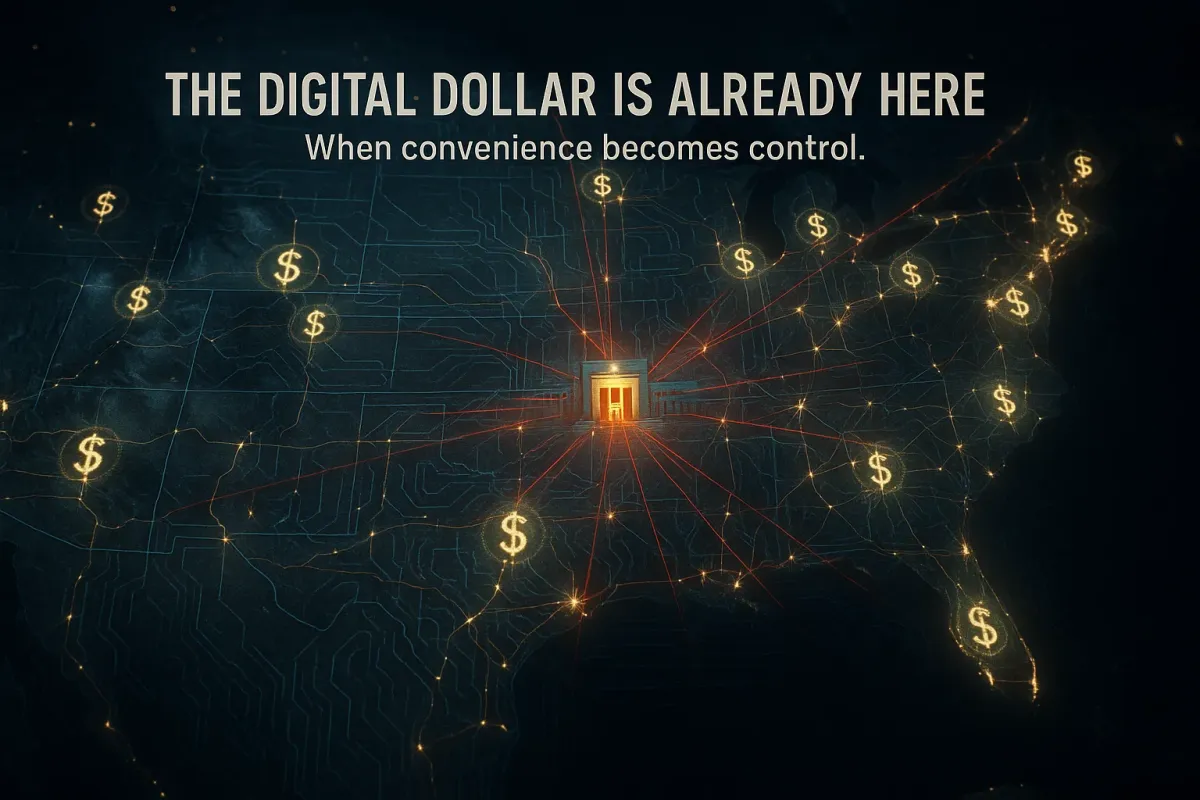
The Digital Dollar Is No Longer a Theory - It's Already Here...While America's distracted, the Fed quietly launched FedNow - a 24/7 instant payment system that's laying the foundation for a U.S. Central Bank Digital Currency (CBDC).
They claim it's about speed and convenience...
But beneath the surface, a system of surveillance and control is being built impacting our financial privacy and freedom.
Ask yourself:
- If every transaction becomes digital, what happens to your privacy?
- Could "programmable money" be used to limit how - or where - you spend?
- Could access to your savings or retirement be limited by someone else's rules?
This isn't hypothetical.
FedNow is already live. The rails are in place.
And even Trump - who once criticized digital currencies - is now supporting a national crypto reserve... and has adopted projects like Trump-themed tokens.
The writing is on the wall. Once this system is fully operational, opting out may no longer be an option. If adoption becomes widespread, preserving financial alternatives could become impossible.
That's why this free guide is so urgent. It reveals the real risks - and what you can do right now to protect your financial freedom before it's too late.
Get the guide now. While you still can.
What Makes a CBDC Different
People hear "digital currency" and think Bitcoin. Ethereum. Crypto. But a Central Bank Digital Currency (CBDC) is fundamentally different—not just in design, but in purpose.
Here's what separates them:
Cryptocurrency (when used correctly):
- Decentralized: No single authority controls the network.
- Pseudonymous: Transactions are transparent but not tied to government ID.
- Permissionless: Anyone can send or receive without approval.
CBDC:
- Centralized: Every transaction passes through government-controlled infrastructure.
- Fully traceable: Every payment is logged, timestamped, and tied to verified identity.
- Programmable: Money can be coded with rules—expiration dates, spending limits, category restrictions.
That last point is critical. Programmable money means the government (or whoever controls the system) can dictate not just how much you have, but how you spend it.
Imagine stimulus payments that expire in 30 days—forcing you to spend or lose the money. Fuel allowances capped at 10 gallons per week "for climate goals." Donations to certain organizations flagged as "high-risk" and requiring additional verification. Purchases of gold, firearms, or even foreign currency restricted "for financial stability."
This isn't speculation. It's capability—and capability, once built, is eventually used.
| Feature | Cash | CBDC | Gold / Physical Assets |
|---|---|---|---|
| Traceable | No | Fully | No |
| Programmable | No | Yes | No |
| Inflation Proof | No | No | Yes |
| User Control | Full | Limited | Full |
This table isn't advocacy. It's taxonomy. Cash offers privacy and autonomy but is being phased out globally. CBDCs offer efficiency and control—at the cost of surveillance. Physical assets like gold and silver remain outside the digital grid entirely, which is why governments historically restrict or confiscate them during crises.
When Freedom Becomes a Toggle: The Global Precedent
This isn't hypothetical. It's operational. And the patterns are unmistakable.
China's Digital Yuan:
Over 260 million users. Transactions monitored in real time. Purchases of "politically sensitive" materials flagged. Spending limits applied based on social credit scores. The system doesn't just track—it restricts. And it does so silently, algorithmically, without explanation.
EU's Digital Euro Pilot:
Scheduled rollout by 2026. Privacy advocates warned early, but the European Central Bank's own documents reveal that transactions above certain thresholds will be automatically reportable to tax authorities. The system architecture allows for programmable spending limits during "economic emergencies."
Canada's 2022 Account Freezes:
During the trucker protests, the Canadian government invoked emergency powers to freeze bank accounts—protesters, donors, even journalists covering the event. No trials. No court orders. Just a directive, and accounts went dark. The mechanism already existed in the banking system. A CBDC makes it instant and unappealable.
The precedent is set. The infrastructure is proven. And the argument is always the same: "Security. Efficiency. Stability."
But the result is control. Total, algorithmic, and irreversible once deployed at scale.
The Political Paradox: When Control Becomes Bipartisan
Here's where it gets uncomfortable: the shift toward digital control isn't partisan.
Trump, once critical of government-issued digital currencies, now backs a "Strategic Bitcoin Reserve" and supports regulated crypto infrastructure. Why? Because digital power is too valuable to reject—regardless of party.
Democrats want centralized oversight for "equity" and "inclusion."
Republicans want it for "national security" and "competitiveness."
Both sides recognize that control over money is control over behavior, and neither is willing to cede that power to the other—or to citizens.
So the infrastructure advances. Bipartisan votes. Quiet approvals. Regulatory frameworks that "modernize" the system while embedding mechanisms for surveillance and restriction.
The digital dollar isn't a left or right issue. It's a power issue. And power, once centralized, is never voluntarily returned.
What Programmable Money Means for You
Zoom back in. Not to global policy, but to daily life.
Imagine waking up to discover your account is flagged. Not frozen—just flagged. Certain transactions require additional verification. Your donation to a political campaign? Held for review. Your purchase of precious metals? Subject to limits. Your transfer to a family member abroad? Delayed pending "risk assessment."
You call the bank. They say it's automated. You call the IRS. They say it's a systemic flag. No one can tell you why. No one can tell you when it will clear. You're not accused of a crime. You're just caught in the algorithm.
This is the personal fallout of programmable money. Not dystopia—just friction. And friction, applied systematically, becomes control.
Every donation is auditable.
Every purchase is categorized.
Every pattern is analyzed.
And every deviation from "normal" triggers scrutiny.
It's not that privacy disappears all at once. It's that it erodes one transaction at a time, until you realize you've been conditioned to ask permission for what used to be a right.
Legal Options While They Still Exist
So what can you do?
The answer isn't panic. It's positioning—moving a portion of wealth outside the digital grid while the door is still open.
Here are the legal, IRS-approved strategies:
1. Self-Directed IRAs with Physical Metals:
Section 408(m) allows qualified individuals to move retirement funds into physical gold or silver, held in IRS-approved custody. No penalties. No immediate taxes. Just a shift from paper assets to tangible stores of value that can't be programmed or frozen remotely.
2. Cash Reserves:
Keep physical currency on hand—enough to cover weeks or months of expenses. Once cash is phased out, this option disappears.
3. Non-Custodial Cryptocurrency:
For those willing to learn the tech, holding crypto in private wallets (not on exchanges) offers a parallel financial system outside centralized control.
4. Diversified Physical Assets:
Land, collectibles, commodities—anything tangible that holds value independent of digital ledgers.
This isn't about rejecting the modern economy. It's about maintaining optionality—keeping one foot outside the system while it's still legal to do so.
Because once the digital dollar becomes mandatory, once cash is phased out, once programmable restrictions are normalized—opting out won't be a choice. It will be a crime.
The FedNow network is live — and with it, the foundation for a fully traceable, programmable dollar.
But there’s still time to stay outside the system.
Learn how Americans are using tangible, IRS-approved assets to protect their privacy, savings, and retirement from digital control.
The ATM screen still blinks. "Temporarily Unavailable."
But the truth is, it's not temporary. It's transitional. The old system—cash, privacy, autonomy—is being phased out. Not with announcements or debates, but with infrastructure upgrades that sound boring until you realize what they enable.
The rails are already humming beneath our feet. FedNow is operational. CBDC pilots are running. The legal frameworks are being drafted. And most people still think it's just about faster payments.
But those watching closely understand: the digital dollar is already here. Not fully deployed, not yet mandatory—but built, tested, and waiting for the policy shift that makes it universal.
The only question left is who the rails will carry—and who they'll cage.
—
Claire West