Inside Microsoft's Secret Factory: The Rise of Exegesis AI
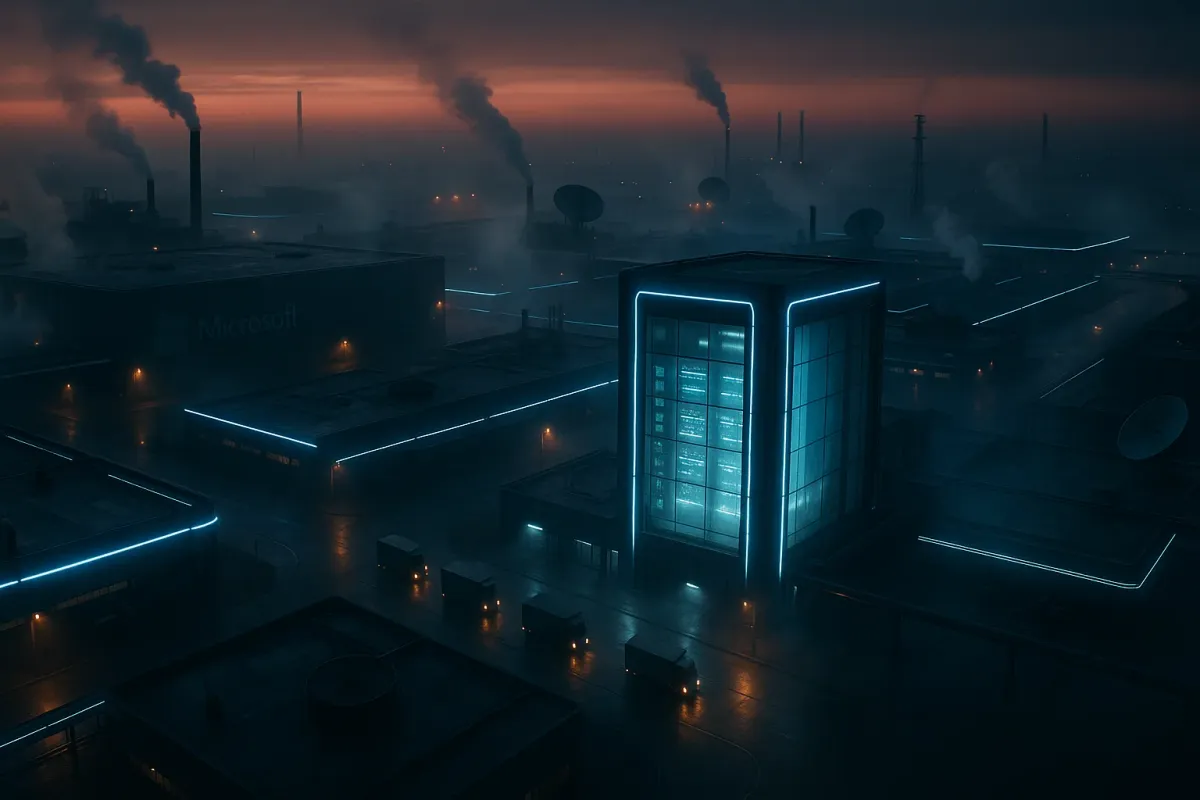
The drive through Iowa's heartland is usually featureless—cornfields stretching to the horizon, broken only by silos and the occasional farmhouse. But just outside Des Moines, something interrupts the pattern.
A construction site, massive and sealed. Chain-link fencing wrapped in opaque mesh. The Microsoft logo stamped on entrance gates. Drones circling overhead in choreographed loops, their lights blinking red against the dusk. And beneath the industrial scaffolding, a faint mechanical hum—low, steady, almost rhythmic—that carries across the fields as the sun sets.
Locals call it "the AI plant," though no one quite knows what that means. Truck drivers report deliveries at odd hours. Permits mention cooling systems, power substations, and "advanced computational manufacturing." But the language is vague, the access restricted, and the explanations nonexistent.
This isn't a data center. Microsoft has built dozens of those. This is something else—something that marks a fundamental shift in what the company is, what it builds, and what it means for the economy at large.
This is the beginning of Exegesis AI. And it's changing everything.
The Factory That Shouldn't Exist
For nearly five decades, Microsoft has been a software empire. Windows. Office. Azure. Code, cloud, licenses—immaterial products scaled infinitely, delivered through cables and satellites, monetized through subscriptions.
But AI changes the equation.
Unlike software, which runs on existing infrastructure, AI at scale demands physical presence: custom chips designed for parallel processing, liquid cooling systems that rival power plants, energy grids that can handle sustained megawatt loads, and supply chains for rare-earth metals that don't exist in sufficient quantity today.
So Microsoft is doing what it's never done before: building industrial plants. Not just server farms, but manufacturing and processing hubs where hardware, energy, and computation converge.
The Des Moines site is one of at least four confirmed facilities under construction. Others are rumored in Arizona, Nevada, and Tennessee—states offering tax incentives, proximity to power grids, and distance from regulatory scrutiny.
This marks the shift from code to concrete. From digital dominance to industrial control. And it signals that the AI race isn't just about who writes the best algorithms—it's about who can build the physical infrastructure to run them at scale.
Microsoft is building a factory.
Not a software update. Not a new gadget.
An actual factory — massive, humming, and unlike anything America’s ever seen from them.
We got close. We filmed it.
And what we captured will make you rethink what’s coming next.
Because while everyone assumes Microsoft is just pushing Office and Windows, they’re laying down the foundation for a whole new power structure.
One that I called “Exegesis AI” and that could make or break fortunes in the months ahead.
Don’t just take my word for it - see the footage yourself.
Exegesis AI: The Framework That Reads and Reasons
The name Exegesis surfaced first in leaked permit filings, then in internal Microsoft documents obtained by industry analysts. The term, borrowed from theology, means "critical interpretation"—the act of reading text to extract deeper meaning.
In Microsoft's context, Exegesis AI is the framework designed to read and reason across massive corporate datasets, automating decisions that currently require human judgment. Not just data analysis, but strategy formation, resource allocation, personnel evaluation—the core functions of management itself.
Here's the vision: Companies feed Exegesis their operational data—sales, logistics, HR, finance. The system doesn't just report trends; it makes recommendations, executes trades, reallocates budgets, and flags inefficiencies in real time. It doesn't assist managers. It replaces them.
The implications are staggering. If Exegesis works as intended, entire layers of corporate hierarchy—middle management, operations directors, even C-suite analysts—become redundant. The AI doesn't need meetings, sleep, or equity compensation. It processes, decides, and executes.
This isn't automation of blue-collar tasks. It's the industrialization of white-collar decision-making. And Microsoft isn't building it as software-as-a-service. It's building it as infrastructure—hardware and energy systems that companies lease access to, the same way they lease cloud storage.
The factory in Iowa? It's not producing software. It's producing the physical backbone of Exegesis—processing nodes, cooling arrays, and the energy grids required to run them continuously.
The Economic Undercurrent
Microsoft's move into physical AI infrastructure isn't happening in isolation. It's part of a broader industrial race between Big Tech and Big Energy—a convergence that will reshape supply chains, labor markets, and geopolitical leverage.
Consider the dependencies:
- NVIDIA supplies the GPUs that power AI training. Microsoft is now NVIDIA's largest customer, but also a competitor—Microsoft is developing its own chips to reduce dependence.
- Rare-earth metals—lithium, cobalt, tantalum—are essential for advanced processors and cooling systems. China controls 80% of global supply. Any Microsoft facility is now a strategic asset tied to mineral geopolitics.
- Energy grids must expand. AI processing consumes power at industrial scale. Microsoft's plants are negotiating direct connections to nuclear and natural gas facilities, bypassing traditional utility infrastructure.
- Federal contracts are already in play. The Department of Defense has awarded Microsoft multi-billion-dollar deals to develop AI decision-support systems. Exegesis isn't just corporate tooling—it's being built for military and intelligence applications.
This is the economic undercurrent: AI is leaving the cloud and entering the physical economy—manufacturing, energy, logistics, defense. And whoever controls that infrastructure controls the next industrial era.
| Phase | Old Microsoft | Exegesis AI Microsoft | Investor Signal |
|---|---|---|---|
| Core Product | Software & Cloud | AI Hardware & Energy | Infrastructure Upside |
| Revenue Model | Licensing | Processing Leasing | Recurring Industrial Flow |
| Market Impact | Digital | Physical | Cross-sector Shock |
This table captures the transformation. The old Microsoft sold software licenses and cloud subscriptions—high-margin, low-infrastructure. The new Microsoft is building physical plants, negotiating energy contracts, and positioning itself as the utility provider for the AI economy.
The revenue model shifts from one-time licenses to continuous processing leases—companies paying for compute time the way they pay for electricity. The margins are thinner, but the scale and stickiness are unprecedented.
For investors, this signals a different kind of opportunity. Not just Microsoft stock, but the entire supply chain: chip manufacturers, cooling system providers, energy infrastructure, rare-earth mining, and logistics networks required to support physical AI plants.
Winners & Losers
When AI leaves the cloud and enters the grid, the economic winners shift.
Winners:
- Infrastructure hardware companies: Those producing chips, cooling systems, power management tools, and custom processors will see explosive demand.
- Energy providers: Natural gas, nuclear, and renewable providers with direct-connection capacity become strategic partners.
- Rare-earth suppliers: Companies with mining rights and processing facilities outside Chinese control gain leverage.
- Logistics networks: Moving components between plants and maintaining continuous supply chains becomes critical.
Losers:
- Traditional cloud providers that don't pivot to physical infrastructure risk becoming commoditized.
- White-collar workers in management, operations, and strategy roles face obsolescence if Exegesis scales successfully.
- Small competitors: The capital required to build AI plants is prohibitive. This consolidates power among a handful of giants.
The shift is profound. AI was supposed to be democratizing—anyone with a laptop could train models. But industrial AI requires billions in capital, years of construction, and geopolitical alliances most startups can't access.
Investor Reflection: Pattern Recognition, Not Hype
This isn't speculation. It's observation.
Every industrial revolution starts quietly with a factory no one was supposed to notice. The textile mills of Manchester. Ford's assembly lines in Detroit. TSMC's chip fabs in Taiwan. By the time the world recognizes the shift, the winners are already entrenched.
Microsoft's Des Moines plant—and the others like it—represent that inflection point. The company isn't just expanding into AI. It's redefining what a technology company is: part software firm, part manufacturer, part energy conglomerate.
For those watching closely, the signals are clear:
- Permit filings for energy infrastructure.
- Supply contracts with rare-earth processors.
- Federal partnerships for defense AI.
- Hiring surges in industrial engineering, not just software development.
The pattern isn't subtle. It's just early. And early is where asymmetric returns live—not in following headlines, but in recognizing when the landscape shifts before consensus catches up.
What if AI wasn’t in the cloud — but in a factory you could see from space? Our latest report uncovers Microsoft’s secret build, the hidden partners behind it, and the early-stage stocks set to ride this industrial AI boom.
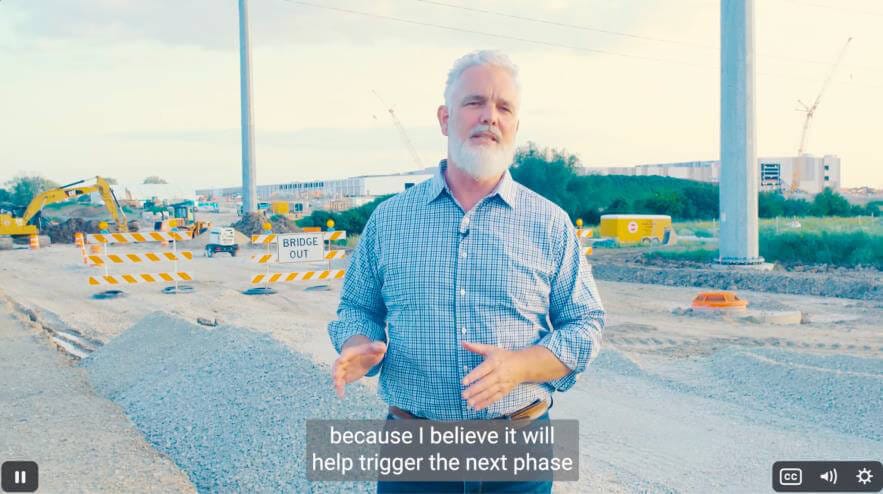
Shocking Footage of Microsoft’s New Factory
Brownstone Research
Standing outside the gates as night falls, the hum is louder than expected. Not the whine of servers in a data center, but something deeper—mechanical, rhythmic, almost organic.
The locals were right to call it a heartbeat. Because what's being built here isn't just infrastructure. It's the circulatory system of the AI economy—processing power flowing like blood through arteries, decision-making distributed across nodes, intelligence embedded in every transaction.
They call it automation. But standing here, listening to that steady pulse, it sounds less like replacement and more like something emerging—something that doesn't fit the old categories of software or hardware, cloud or factory, code or concrete.
It sounds like the future, humming quietly in a cornfield, waiting for the world to catch up.
—
Claire West