Personal Computers. Internet. EVs. Now Robotics — The Pattern Repeats (And Most People Miss It)

The robotics exhibit sits in a quiet corner of the science museum—the kind of section most visitors pass quickly on their way to flashier displays. I linger here, studying the prototypes behind the glass.
A mechanical arm from 1985, thick as a tree trunk, designed to weld car frames. A humanoid torso from 2003, its face frozen in an unsettling half-smile, servos visible beneath translucent plastic skin. A walking robot from 2012, legs like stilts, balance so precarious you can almost feel it tipping over.
They look clunky, fragile, slightly absurd—relics of ambitions that exceeded capabilities. The plaques describe each as "revolutionary for its time," which is museum-speak for "we've come a long way since then."
But standing here, I'm not thinking about how far we've come. I'm thinking about how innovations always look silly right before they change everything.
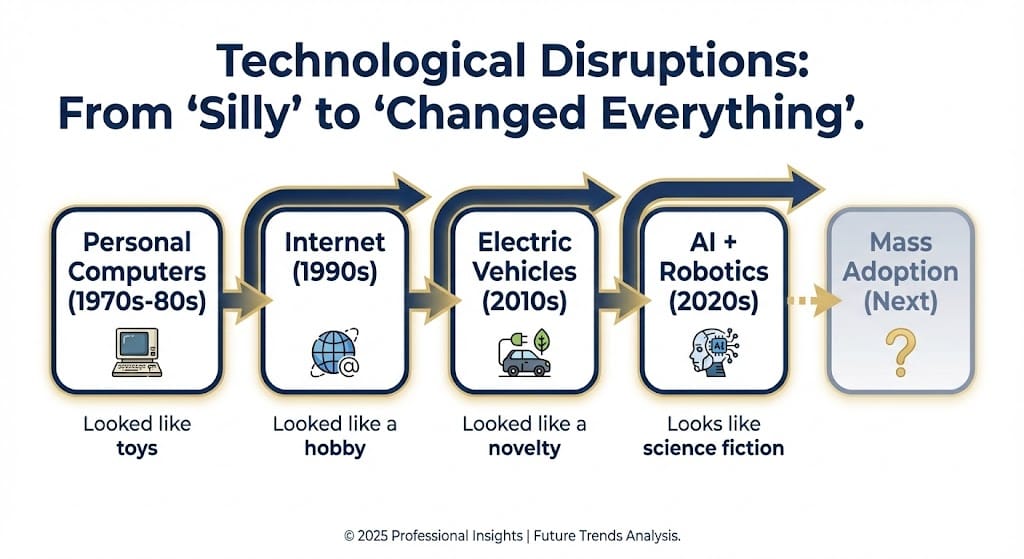
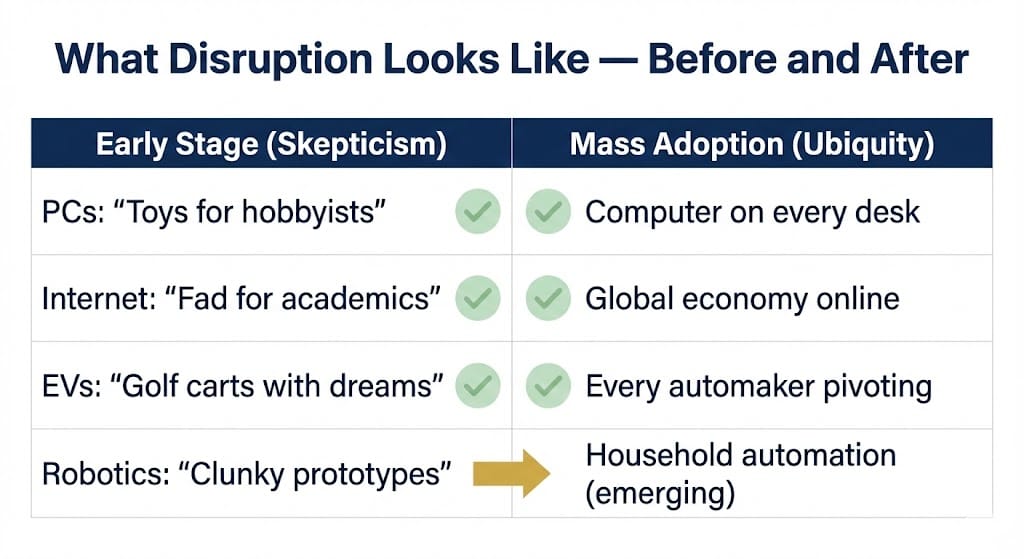
The first personal computers looked like toys. The early internet looked like a hobby for academics. The first electric cars looked like golf carts with delusions of grandeur. And early AI—chatbots that couldn't hold a conversation, image recognition that confused dogs with muffins—looked like parlor tricks.
Sometimes the next big shift begins not with a roar, but with a quiet reveal. And only a few people recognize the magnitude in real time.
The Long Arc of Disruption
I've studied these patterns long enough to recognize the shape they take.
Personal computing (1970s-80s): IBM executives famously dismissed microcomputers as irrelevant to serious business. Hobbyists tinkered in garages while the establishment built mainframes. Then, seemingly overnight, a computer sat on every desk, in every home, and the mainframe era ended.
The internet (1990s): Early adopters dialed up on screeching modems to browse text-heavy pages with broken images. Skeptics called it a fad for technophiles. Then e-commerce emerged, then social media, then streaming, and the entire global economy reorganized around infrastructure that once seemed impossibly fragile.
Electric vehicles (2010s): Tesla was a punchline for years—burning cash, missing production targets, building cars that "real" automakers dismissed as niche products for California environmentalists. Then battery costs plummeted, range improved, and suddenly every major manufacturer was scrambling to catch up with a company they'd laughed at.
Artificial intelligence (2020s): ChatGPT launched as a curiosity—a chatbot that could write poetry and debug code, impressive but seemingly limited. Within months, it had 100 million users. Within two years, AI was embedded in every major software platform, reshaping industries faster than regulations could adapt.
The pattern is consistent: early iterations look primitive, adoption seems improbable, and then the inflection arrives faster than anyone outside the field anticipated.
The Inflection Point We're Currently Standing In
We're in another one of those moments now. The convergence of AI and robotics—two fields that have developed largely in parallel—is reaching an inflection point that most of the public hasn't yet registered.
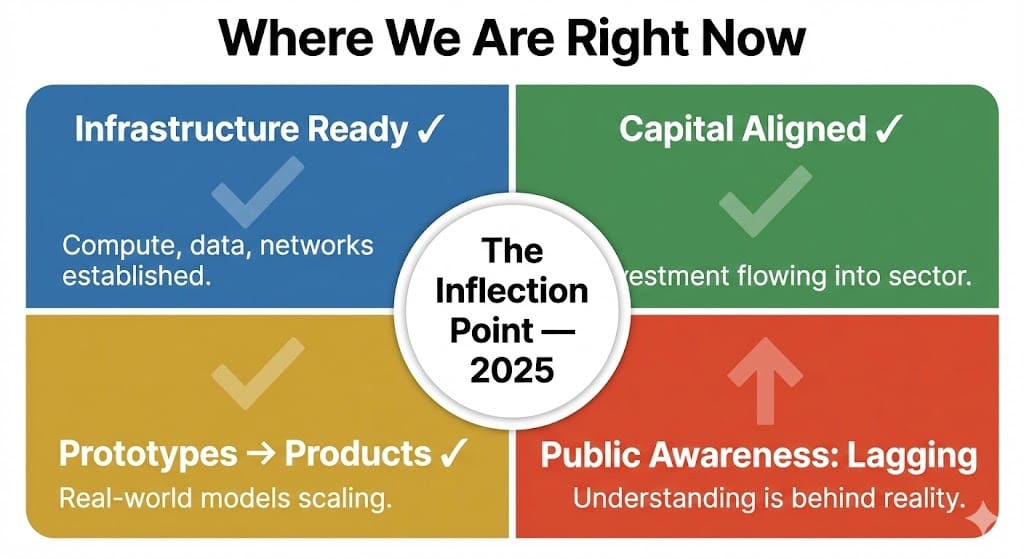
The infrastructure is ready. Processing power that once required warehouse-sized data centers now fits in compact form factors. Computer vision has achieved human-level accuracy in controlled environments. Large language models can interpret natural instructions and translate them into machine actions.
Capital is aligned. Venture investment in robotics has surged. Major technology companies are pouring billions into humanoid platforms, autonomous systems, and industrial automation. The money is moving before the products are mainstream—always a signal.
Prototypes are becoming products. What lived in research labs five years ago is now entering pilot production. What looked like science fiction demonstrations is now appearing in warehouse fulfillment centers, manufacturing floors, and early consumer applications.
And public awareness? Still lagging. Still focused on the awkward prototypes, the stumbling demonstrations, the viral videos of robots falling over. The gap between what's actually happening in engineering labs and what the public perceives is wider than at any point I can remember.
This is the moment before mass adoption. Not the arrival—the anticipation. The infrastructure assembled, the capital committed, the technology maturing—all waiting for the catalyst that tips curiosity into ubiquity.
Elon’s about to shock the world — again.
He’s not unveiling a new car.
He’s about to deploy robots. Real, walking, working robots powered by Tesla’s AI brain.
Jeff Brown — the man who called Tesla at $70 and Nvidia before its 23,000% run — says this is Elon’s “250X ChatGPT moment.”
And he’s naming one $50 stock that makes it possible.
Before these robots roll out, you have a tiny window to act.
Because when Elon reveals what’s coming next… every late investor will chase.
The Engineers Working Quietly
In labs across the country, engineers are working on breakthroughs the public still sees as far-off. Dexterous manipulation—robots that can handle objects with human-like precision. Adaptive learning—systems that improve through interaction rather than explicit programming. Energy efficiency—platforms that can operate for hours rather than minutes.
Tech analyst Jeff Brown—the man who called Tesla at $70 and Nvidia before its 23,000% run—says this is Elon's "250X ChatGPT moment." And he's naming one $50 stock that makes it possible.
I mention this not as endorsement, but as context. The pattern I've described—early skepticism, infrastructure buildout, capital alignment, and then rapid adoption—applies to robotics as clearly as it applied to personal computing, the internet, and AI. Those who recognized previous inflection points early positioned themselves accordingly. Those who waited for mainstream validation bought at different prices.
What Robotics Really Means for Households
The conversation about robotics often stays abstract—industrial applications, manufacturing efficiency, warehouse logistics. But the deeper shift will be personal.
Think about how earlier technologies reshaped daily life. Washing machines didn't just clean clothes—they returned hours of labor every week. Dishwashers, vacuum cleaners, microwaves—each automation freed time that could be redirected toward work, family, rest, or creativity.
Robotics represents the next layer of that evolution. Not replacing humans, but augmenting human capacity. Handling repetitive tasks. Managing household logistics. Providing assistance for aging populations who want to maintain independence.
The "value of time" will shift. When physical tasks that currently require hours can be delegated to machines, the economics of daily life change. What you do with your time becomes more valuable than the tasks you no longer need to perform.
I think often about how my parents' generation adapted to personal computers—the initial resistance, the gradual adoption, the eventual wonder at how they ever managed without email and spreadsheets. The same adaptation will happen with robotics. What feels intimidating or futuristic today will feel normal and indispensable within a decade.
The Risk of Not Paying Attention
Here's the tension I navigate constantly: ignoring emerging shifts is how people miss generational wealth cycles. But chasing headlines is equally dangerous.
The investors who captured the PC revolution didn't buy every computer company—most failed. The investors who captured the internet boom didn't buy every dot-com—most collapsed. The winners emerged from the chaos, and identifying them required understanding the underlying technology, not just following the hype.
The same applies now. Robotics will create enormous value—but it will also destroy value in companies that fail to adapt, in business models that become obsolete, in investments made without understanding the structural shifts underway.
The right move isn't panic or FOMO. It's calm observation and intentional positioning. Understanding what's changing, why it matters, and how to evaluate opportunities without being swept up in either dismissal or euphoria.

I take one more look at the prototypes behind the glass. The mechanical arm, the awkward humanoid, the stumbling walker. Each represented the cutting edge of its era. Each looked slightly ridiculous to contemporary observers. And each was a step on a path leading somewhere far beyond what its creators could fully imagine.
One day, these exhibits will look like ancient relics compared to what's coming next. The robots that seem impressive today will seem as primitive as these prototypes seem to us. And the inflection point we're currently standing in—the moment before mass adoption—will be visible only in retrospect.
That's how it always works. The signals are quiet. The magnitude is hidden. And only those paying attention recognize the shift before it becomes obvious to everyone else.
I leave the museum as the afternoon light softens. The future is assembling itself in labs and factories, in code and capital, in prototypes that still stumble but won't stumble forever.
The question isn't whether the change is coming. It's whether you'll recognize it while preparation is still possible.
—
Claire West