The Illusion of Escape
It is a Tuesday morning in 2025. A press release crosses the terminal: a small-cap energy company announces a merger with a fusion startup. The stock jumps 40 percent in pre-market trading. The press release contains no revenue, no commercialization timeline, no physics details beyond "breakthrough potential." It contains one critical element: permission to exist as a publicly traded fusion vehicle.
Markets are not reacting to energy. They are reacting to the idea of escape from constraints.
This pattern repeats every generation. The 1950s promised "electricity too cheap to meter" from nuclear fission. The 1970s and 1980s promised hydrogen economies. The 2000s promised cellulosic ethanol and clean coal. The 2020s promise fusion and green hydrogen. Each wave follows the same arc: narrative precedes physics, capital precedes cash flow, permission precedes production.
Understanding this pattern is the difference between investing in headlines and investing in infrastructure.
Announcement vs. Substance
When a company announces a merger with a fusion startup, the stock moves not because fusion is imminent, but because the announcement grants permission for investors to buy fusion exposure. The vehicle exists. It is listed. It has a ticker. It has political backing. These are the ingredients markets price before they price physics.
The substance—actual fusion reactors producing net energy—remains decades away. ITER, the world's largest fusion project, has delayed first plasma from 2025 to 2034, with full D-T operation not expected until 2039. The project has cost overruns of €5 billion and counting. This is not criticism. It is reality. Fusion is hard. It has always been hard.
Yet markets react to announcements because announcements signal permission: regulatory approval, political will, capital formation. The stock moves on the idea that someday, perhaps, fusion will be real. The timeline is irrelevant to the price action. The permission is what matters.
This is why merger announcements tied to "breakthrough energy" move stocks long before the underlying physics or commercialization timelines are clear. The market is pricing optionality, not output.
Editor's Note: Wall Street legend Larry Benedict warned about the oil crash in 2022 before oil lost 50% of its value. Today, he’s making another big call in energy. While everyone is focusing on crypto, NVIDIA, and the rest of the Magnificent Seven, he believes one little-known company has a virtual stranglehold on the only real option to power the AI boom. Click here for details or read more below.
This is the best-performing stock in oil & gas this year.
It doesn’t drill…
It doesn’t find new deposits…
It doesn’t do much of anything at all.
But somehow, this “lazy” company beat out every oil and gas stock you’ve heard of…
It’s called the San Juan Basin Trust (SJT), and the company’s sole purpose is to collect royalties from the gas-rich San Juan Basin.
In short, when gas does well, so does SJT.
So far, it’s up 51% thanks to the incredible AI-powered surge in natural gas…
But the former manager of funds for Saudi Arabia’s wealth fund is stepping forward with an even better way to play this bubbling energy market.
He’s talking about 6x the gains of SJT…
From just three trades.
And he sees a lot more opportunity as gas continues to surge.
Click here now to see the best play in oil and gas.
A Short History of 'Limitless Energy' Moments
Nuclear (1950s): The Original "Too Cheap to Meter"
In 1953, President Eisenhower delivered his "Atoms for Peace" speech, promising to redirect nuclear weapons technology toward peaceful electricity generation. The narrative was intoxicating: abundant, cheap, clean energy for all. The U.S. Atomic Energy Commission projected nuclear would provide electricity "too cheap to meter".
What scaled? Naval propulsion, medical isotopes, and baseline grid power from fission reactors. What remained theoretical? The economic miracle. Nuclear plants proved capital-intensive, regulation-heavy, and slow to build. By the 1980s, nuclear construction stalled in the U.S. due to cost overruns and public opposition. The narrative of limitless energy collided with the physics of cost and complexity.
Fusion Waves: Always 20 Years Away
Fusion has been "20 years away" since the 1950s. In 2016, ITER announced first plasma by 2025. In 2024, that date slipped to 2034. Each delay is rationalized by technical complexity. Each announcement generates headlines. Each headline moves capital toward fusion ventures, despite no commercial reactor ever producing net energy.
The pattern: announcements create permission for capital formation. Capital flows to fusion startups, SPACs, and research programs. The physics remains unchanged. The timeline extends. The capital is either lost or redirected.
Hydrogen Booms: The Clean Fuel That Never Arrives
Hydrogen experienced a boom in 2020-2021, driven by EU hydrogen strategies and U.S. IRA subsidies. Stocks like Plug Power surged from $5 to $60. By 2025, Plug Power trades near $1, down 95 percent. Over 95 percent of announced hydrogen projects since 2020 have been canceled. The S&P Kensho Global Hydrogen Economy Index fell to mid-2020 levels, erasing all gains.
What scaled? Industrial hydrogen for refining and chemicals (gray hydrogen). What remained theoretical? Green hydrogen at scale for transportation and power. The narrative of a hydrogen economy collided with the physics of cost: green hydrogen remains $5-10/kg, far above fossil-derived hydrogen at $1-2/kg.
The pattern repeats: narrative creates permission, capital flows, physics remains stubborn, capital evaporates.
Why Markets Reward Optionality, Not Output
Markets price what can be owned today, not what might exist tomorrow. When a fusion startup merges with a public company, the market gains the ability to own fusion optionality. The price reflects the probability-weighted value of fusion succeeding, discounted by time and risk.
This is why markets reward permission to exist (regulatory access, public listing, political backing) rather than delivered megawatts. A fusion company with a ticker is investable. A fusion reactor in a lab is not.
The same dynamic applies to hydrogen. When the EU announced hydrogen strategies in 2020, it granted permission for capital formation. Hydrogen ETFs launched. Retail investors piled in. The narrative was "hydrogen economy imminent." The physics was "hydrogen remains expensive and uncompetitive." The market priced the narrative. The physics delivered reality.
The AI–Energy Narrative Loop
AI has become the justification layer for every energy proposal, regardless of maturity. Data center power demand is real and growing at 22 percent annually. But the narrative has expanded to justify fusion ("AI needs limitless clean energy"), hydrogen ("AI data centers can run on hydrogen"), and even nuclear ("AI requires nuclear baseload").
The loop works as follows:
- AI demand creates a genuine power constraint
- Every energy technology claims it can solve the constraint
- Capital flows to the technology with the most compelling narrative
- The technology with the most compelling narrative is the one furthest from commercialization (because reality is messy, narratives are clean)
This is why AI has become the justification layer for fusion, hydrogen, and next-generation nuclear. The narrative is: "AI is too important to wait for physics." The reality is: "Physics does not care about AI's timeline".
Energy Breakthrough vs. Energy Infrastructure
| Dimension | Energy Breakthrough | Energy Infrastructure |
|---|---|---|
| Timeline | Decades (fusion: 2039+, hydrogen: 2030+) | Years (gas plants: 2-5, pipelines: 3-7) |
| Capital Intensity | Extreme ($20B+ for ITER, billions for hydrogen hubs) | High but predictable ($500M-$2B per plant) |
| Regulatory Friction | Extreme (nuclear safety, fusion unknowns, hydrogen standards) | Moderate (known permitting paths) |
| Revenue Visibility | Zero (no commercial sales) | High (long-term contracts, usage fees) |
| Market Reaction | Stock moves on announcements | Stock moves on cash flows |
| Investor Base | Venture capital, retail (speculative) | Institutional, infrastructure (yield-focused) |
| Physics Risk | High (unproven at scale) | Low (proven technology) |
| Political Risk | High (subsidies can vanish) | Low (essential services) |
| Cash Flow | Negative (burn rate) | Positive (recurring revenue) |
| Scalability | Unknown (lab to grid unknown) | Known (modular expansion) |
The gap between columns is where capital is lost or preserved. Breakthroughs capture headlines. Infrastructure captures cash flows.
Where Real Money Tends to Move First
Capital historically enters adjacent suppliers, enablers, and "boring" operators before headline technologies mature.
When nuclear was announced in the 1950s, capital flowed to uranium miners and reactor component manufacturers, not to fusion research. When hydrogen boomed in 2020, capital flowed to electrolyzer manufacturers and industrial gas companies, not to green hydrogen production (which remains unprofitable). When AI power demand surged in 2024-2025, capital flowed to natural gas pipeline operators and power plant owners, not to fusion startups.
The pattern: capital moves to the infrastructure layer that enables the breakthrough, not the breakthrough itself. This is because infrastructure has revenue visibility, regulatory permission, and proven physics.
The AI data center boom is no different. The real money is moving to:
- Natural gas pipeline operators (dispatchable power)
- Power plant owners (long-term contracts with data centers)
- Transmission infrastructure (grid upgrades)
- Royalty trusts on existing gas reserves (volume guarantees)
These are not exciting. They are not in headlines. They generate cash flows today while fusion remains theoretical.
Caution Without Cynicism
This is not an argument against breakthroughs. Fusion may eventually work. Hydrogen may eventually be economical. Next-generation nuclear may eventually be deployed. But investing requires proximity to cash flow, not headlines.
The distinction is critical: breakthroughs matter for humanity, but they are not investable until they have revenue visibility, regulatory permission, and proven physics. Until then, they are science projects, not businesses.
Caution is not cynicism. It is recognition that physics moves slower than narrative, and capital moves faster than physics. The gap between these speeds is where wealth is lost.
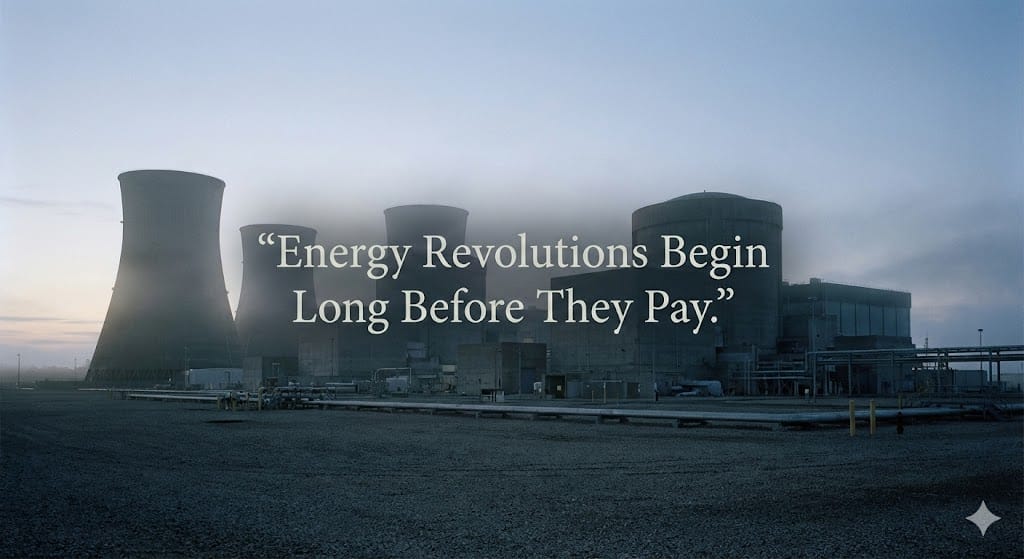
Energy Revolutions Are Slow, Political, and Capital-Heavy
The history of energy is not a history of breakthroughs. It is a history of infrastructure. Coal scaled because railroads existed. Oil scaled because pipelines existed. Natural gas scaled because distribution networks existed. Nuclear stalled because infrastructure was complex and politically fraught. Hydrogen stalled because infrastructure was capital-intensive and economically uncompetitive. Fusion remains theoretical because infrastructure does not yet exist at any scale.
Energy revolutions are not technological. They are infrastructural, political, and capital-intensive. They require decades of investment, regulatory alignment, and public acceptance. They are not traded on headlines. They are built by "boring" operators who collect cash flows while narratives inflate and deflate.
Patience is not a flaw in energy investing. It is a strategy. The assets that matter are not the ones that promise escape from constraints. They are the ones that own the constraints themselves.
Understanding this tension—between narrative and physics, between permission and production, between breakthrough and infrastructure—is the edge that separates capital preservation from capital destruction.
—
Claire West