The Man Quietly Buying Two Tonnes of Gold a Week
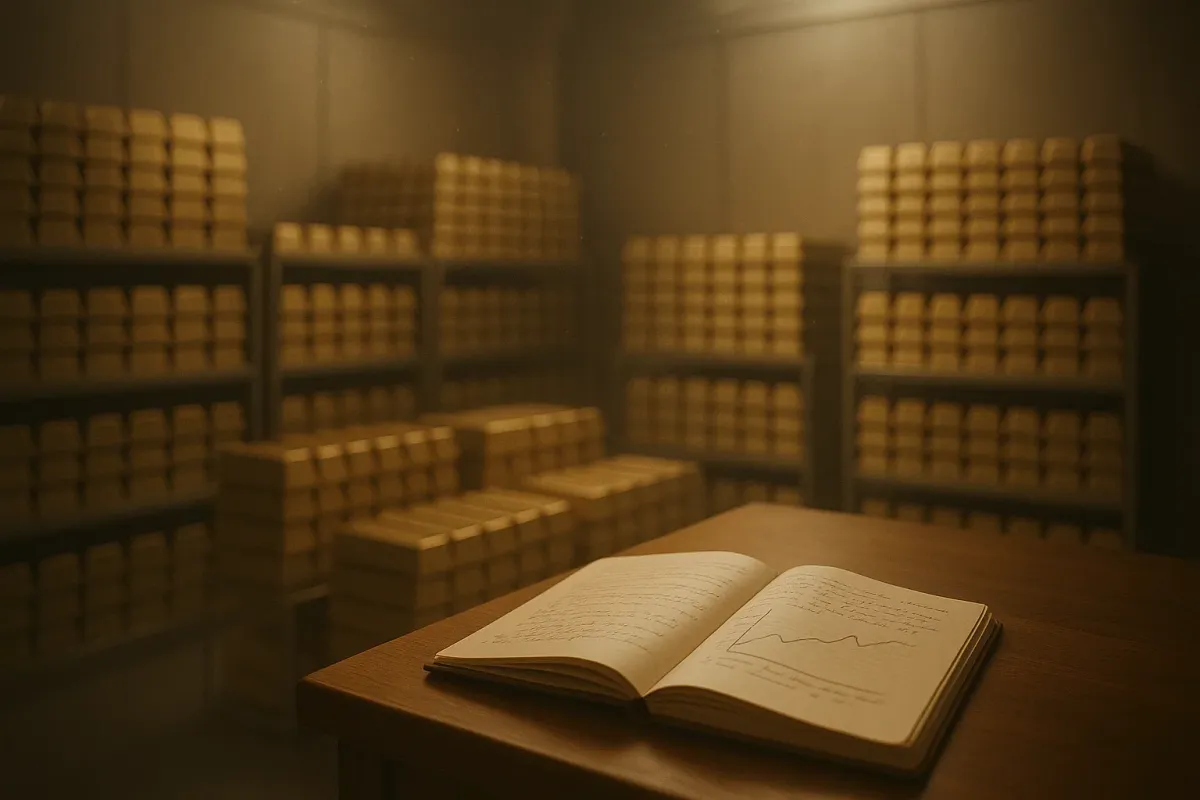
There's a pattern emerging in the global gold market that most investors will never notice. Not because it's hidden, but because the numbers are so large they feel abstract—disconnected from the daily rhythm of portfolios and retirement accounts.
Two tonnes of gold. Every week. For months.
Not a central bank, though they're buying too. Not a sovereign wealth fund repositioning reserves, though that's accelerating. This is private accumulation—high-net-worth individuals and family offices moving capital into physical metal with a consistency that suggests not speculation, but structural repositioning.
The World Gold Council reports that Q3 2025 saw record investment demand of 537 tonnes, with over-the-counter (OTC) flows—the private, institutional transactions that don't hit headlines—adding 55 tonnes in September alone. But buried within those aggregates is a more specific pattern: consistent, large-scale weekly purchases by actors who aren't waiting for dips, aren't timing entries, and aren't concerned with short-term price movements.
They're buying as if they know something the rest of us are only beginning to sense.
Why Private Accumulation Matters
Central bank gold purchases make headlines. Poland added 15.5 tonnes in October. China's been buying for ten consecutive months. Kazakhstan led Q3 with aggressive accumulation despite record-high prices.
But private accumulation operates differently. It's quieter, faster, and often more revealing. Central banks move with bureaucratic inertia—committees, approvals, public justifications. Private buyers move with conviction, capital, and information asymmetry.
When you see two tonnes per week flowing into private hands, it signals three things:
Fear of system fragility. The wealthy don't diversify into gold because they think it will outperform tech stocks. They buy it because they're hedging against scenarios where paper assets become unreliable—currency devaluation, bank failures, capital controls.
Loss of confidence in sovereign debt. U.S. Treasuries, once the unquestioned safe haven, now trade with yields reflecting fiscal concern. When high-net-worth investors rotate from bonds to bullion, they're signaling distrust in government's ability to service debt without monetary debasement.
Preparation for monetary reset. This is the uncomfortable truth: the current dollar-based system, untethered from gold since 1971, is 54 years into an experiment with no historical precedent for longevity. Private buyers treating gold as insurance aren't pessimists. They're historians.
So… Who has pockets that deep? And why is he sinking so much money into physical gold?
The story will blow your mind – and has potential to make you rich.
How do I know?
Because I was in the room with the biggest players in the gold universe at a private meeting in Colorado.
What I discovered still keeps me awake at night.
Because if I’m right about what happens next, we’re at the very beginning of a monetary shift unlike anything in modern history.
Gold is returning to the US monetary system for the first time in 54 years.
I urge you to familiarize yourself with the name of the world’s largest gold buyer… Find out why he’s buying gold at this rate… and how you could profit from gold’s next leg up.
How Central Banks React
Central banks aren't oblivious. They're accelerating purchases even as prices hit all-time highs—220 tonnes in Q3 2025 alone, a 28% increase over Q2. Goldman Sachs projects that central bank buying will continue at roughly 80 tonnes per month through 2026, with gold reaching $4,900 per ounce.
Why buy at record prices? Because price is secondary to diversification when confidence erodes.
Emerging market central banks—China, Turkey, India, Kazakhstan—are dramatically underweight gold compared to developed nations. The U.S., Germany, France, and Italy hold roughly 70% of reserves in gold. China? Less than 10%. That structural imbalance is closing, and the reallocation has years left to run.
Russia's recent decision to sell physical gold from reserves—to support the ruble and inject liquidity—underscores the dual role gold plays: both store of value and emergency liquidity during currency stress.
U.S. Dollar Fragility & The 54-Year Gap
August 15, 1971. President Nixon closed the gold window, severing the dollar's convertibility to bullion. It was supposed to be temporary—a response to inflationary pressure and foreign central banks draining U.S. gold reserves.
Fifty-four years later, it's still temporary. And the consequences are compounding.
The dollar now floats on trust—trust in U.S. fiscal discipline, trust in political stability, trust that debt can be serviced without debasement. But that trust is eroding. National debt exceeds $35 trillion. Annual interest payments surpass $1 trillion. And fiscal policy, regardless of administration, remains expansionary.
Gold, in this context, isn't an investment. It's a hedge against the endgame of fiat experimentation. When the world's reserve currency has no anchor, when monetary policy becomes political theater, when debt compounds faster than growth—gold becomes the asset that survives the reset.
Private buyers aren't betting on gold going up. They're betting on everything else becoming less reliable.
Why Individuals Should Pay Attention
Most Americans remain fully exposed to paper assets—401(k)s in equities, savings in banks, pensions denominated in dollars. They trust the system because, for their entire lives, the system has worked.
But systems change. And the signals of change—private accumulation, central bank buying, fiscal stress, geopolitical fractures—are flashing now.
You don't need to become a gold bug. You don't need to abandon markets. But ignoring the pattern because it feels uncomfortable is how wealth transfers from the unprepared to the positioned.
Even a modest allocation—5-10% of net worth—into physical gold or silver creates insulation. Not speculation. Not active trading. Just tangible assets that exist outside the banking system, outside digital ledgers, outside political control.
The wealthy are buying two tonnes a week not because they're panicking. Because they're preparing while preparation is still optional.
The Mechanics of Modern Accumulation
How does someone buy two tonnes of gold weekly without moving markets violently? Through OTC transactions—private deals between institutions, family offices, and bullion banks that settle outside public exchanges.
These flows don't hit COMEX futures. They don't register in ETF inflows. They occur in vaults, through secure custody arrangements, with delivery scheduled months in advance to avoid supply bottlenecks.
The infrastructure exists because demand at this scale has become normalized. What was once rare—private billion-dollar gold positions—is now routine. And the normalization itself signals how far confidence in paper wealth has eroded among those with the most to lose.
The Comparison: Paper vs. Physical vs. Monetary Reset Assets
| Asset Class | Liquidity | Counterparty Risk | Inflation Hedge | System Reset Protection |
|---|---|---|---|---|
| Paper Assets(stocks, bonds) | High | High (bank/broker solvency) | Weak | Vulnerable |
| Physical Gold | Moderate | None | Strong | Strong |
| Monetary Reset Assets(land, commodities) | Low | Minimal | Strong | Very Strong |
This table isn't advocacy. It's taxonomy. Paper assets offer liquidity but require trust in intermediaries and currency stability. Physical gold offers independence but requires secure storage and lower liquidity. Land and commodities provide tangible value but lack portability.
The point: diversification across these categories isn't paranoia. It's structure. And those buying two tonnes weekly understand that no single asset class survives all scenarios.
The Psychology of Preparation
There's a cognitive bias most investors share: normalcy bias—the assumption that tomorrow will resemble today, that systems endure, that disruptions are temporary.
But history teaches otherwise. Every currency eventually fails. Every fiat experiment ends in debasement or reset. Every empire's twilight begins with fiscal fragility disguised as strength.
The wealthy don't assume collapse. They just don't assume stability. And that distinction—between hoping systems hold and preparing for when they don't—is what separates those who preserve wealth from those who watch it evaporate.
The Signal, Not the Noise
Two tonnes of gold, every week, accumulating in private hands. It's not a headline. It's not trending on social media. Most financial advisors won't mention it because it doesn't fit the narrative of "stocks for the long run" or "balanced portfolios diversify risk."
But it's happening. And it's happening because those with the most capital, the best information, and the longest time horizons are positioning for a world where paper promises become less reliable than tangible stores of value.
You don't need to match their scale. But you can mirror their logic: when uncertainty rises, when systems strain, when fiscal discipline collapses—gold doesn't fix the problem. It just outlasts it.

I sit at my desk as evening settles, the glow of market data fading into background noise. The S&P 500 closed higher. Bonds traded sideways. The headlines celebrated resilience.
But beneath the surface, the pattern continues. Two tonnes a week. Private buyers. No announcements. No explanations. Just the quiet accumulation of those who recognize that monetary eras don't end with warnings—they end with realizations, and by then, repositioning is no longer optional.
The window for preparation isn't closing tomorrow. But it's narrowing. And those who wait for consensus—for proof that the shift is real—will discover that proof arrives late, when asymmetry has already vanished and protection costs more than most can afford.
—
Claire West