The Physics Behind the Hype
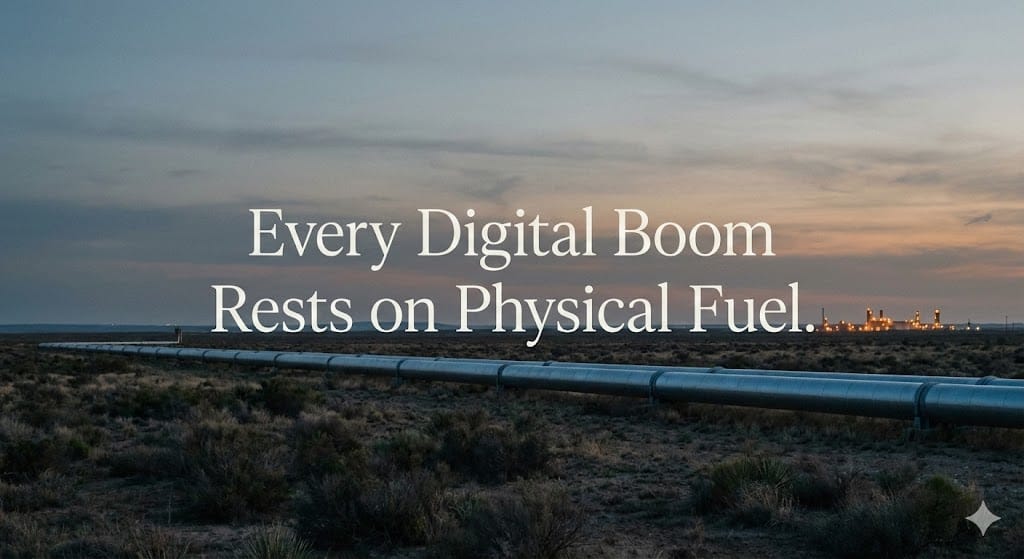
A breakthrough in artificial intelligence creates global headlines. Billions in funding follow. Talent migrates. Venture capitalists pivot strategy. Tech stocks soar. The narrative is electric, revolutionary, transformative.
Then, somewhere very quiet, an engineer at an AI data center realizes there is a problem: the building is overheating. The power demand is spiking unpredictably. The grid cannot respond fast enough. Every kilowatt of artificial intelligence requires a kilowatt of actual electricity—and electricity comes from physics, not code.
By the time this realization reaches capital markets, a much older and far less exciting asset class has already moved: natural gas suppliers, pipeline operators, infrastructure collectors. These are the companies that own the power plants, the dispatchable capacity, the "boring" infrastructure. They are invisible in AI headlines. And they are quietly becoming indispensable to the entire AI economy.
This is the tension that separates speculators from observers: every technological revolution eventually collides with physics. When it does, the least exciting assets often matter most.
The AI Boom's Blind Spot
Narratives cluster around innovation. Chipmakers designing faster processors. AI companies building larger models. Software platforms integrating generative capabilities. These are the stories that move markets, attract venture capital, and dominate headlines.
What narratives almost completely ignore is the layer underneath: energy.
An AI data center consumes eight times the power of a conventional data center. A single modern hyperscale AI facility requires 100+ megawatts of continuous power—equivalent to the peak demand of a large city. Some facilities are being planned at gigawatt scale, which is more power than many coal plants produce.
By 2030, data centers are expected to consume 600+ terawatt-hours of electricity annually—an increase that will require 75-100 additional gigawatts of generation capacity by 2030. For context, this is the entire electricity demand of a major developed nation.
The capital markets tracking AI typically focus on semiconductor producers, software platforms, and enterprise adoption. They miss the most structural constraint: available power.
Editor's Note: Wall Street legend Larry Benedict warned about the oil crash in 2022 before oil lost 50% of its value. Today, he’s making another big call in energy. While everyone is focusing on crypto, NVIDIA, and the rest of the Magnificent Seven, he believes one little-known company has a virtual stranglehold on the only real option to power the AI boom. Click here for details or read more below.
This is the best-performing stock in oil & gas this year.
It doesn’t drill…
It doesn’t find new deposits…
It doesn’t do much of anything at all.
But somehow, this “lazy” company beat out every oil and gas stock you’ve heard of…
It’s called the San Juan Basin Trust (SJT), and the company’s sole purpose is to collect royalties from the gas-rich San Juan Basin.
In short, when gas does well, so does SJT.
So far, it’s up 51% thanks to the incredible AI-powered surge in natural gas…
But the former manager of funds for Saudi Arabia’s wealth fund is stepping forward with an even better way to play this bubbling energy market.
He’s talking about 6x the gains of SJT…
From just three trades.
And he sees a lot more opportunity as gas continues to surge.
Click here now to see the best play in oil and gas.
Natural Gas as the Enabling Input
When engineers at AI data centers evaluate power sources, they face a physics problem that is ruthlessly practical.
Solar and wind are intermittent. They generate power when weather permits, not when demand spikes. AI inference loads exhibit "start-stop" behavior—sudden 10-100 megawatt power swings within seconds. Renewables cannot respond this fast. Neither can nuclear (takes weeks to ramp) or coal (slower response).
Natural gas turbines can ramp up or down within minutes. They respond to rapid load changes. They provide dispatchable power—electricity on demand, when the data center needs it.
This is why the IEA forecasts that gas power for data centers will more than double from 120 TWh in 2024 to 293 TWh by 2035. It is not because gas is "green." It is because gas is the only fuel that currently matches AI's instantaneous power requirements.
To put scale in perspective: data centers' power demand could increase U.S. natural gas production by 10-15 percent by the early 2030s. This is not marginal. This is structural demand growth unrelated to cyclical economic activity. It is driven by one technology: AI.
Why "Lazy" Assets Sometimes Win
An exploration company hunts for new natural gas reserves. It drills wells, faces geological risk, and commits hundreds of millions to find uncertain quantities. It may succeed or fail. Timelines stretch years. Cash flows arrive late.
A natural gas producer extracts reserves and generates cash, but remains exposed to commodity price fluctuations and depletion risk. It must continuously replace reserves or output declines.
An infrastructure operator owns a pipeline or power plant. It collects fees based on throughput—how much gas flows through, or how many megawatts are consumed. It does not care about the commodity price. It does not hunt for reserves. It simply owns the physical pathway between supply and demand.
A gas royalty holder owns the legal right to collect a percentage of revenue from each unit produced. It participates in both volume (if more gas is produced) and price (if the commodity appreciates).
During the AI boom, dispatchable power becomes the constraint. Companies that own dispatchable infrastructure—natural gas plants co-located with data centers, pipelines delivering gas to power plants—capture "scarcity rent" simply by owning the scarce asset.
A lazy royalty holder on gas reserves demanded by AI data centers benefits from:
- Volume growth (guaranteed by AI buildout, not cyclical)
- Price appreciation (dispatchability premium)
- Zero operational complexity (cash flows directly)
This is why "boring" energy infrastructure outperforms during technological booms—not because it is innovative, but because it owns the constraint.
Operational Complexity vs. Cash Flow Simplicity
| Asset Type | Operational Risk | Capital Required | Cash Volatility | Commodity Exposure | Timeline |
|---|---|---|---|---|---|
| Exploration | Very High | Very High ($500M+/well) | Extreme | High | 5-10 years |
| Operator | High (depletion, costs) | High (ongoing capex) | High (price dependent) | High | 2-5 years |
| Royalty Trust | Low | Low | Medium (price only) | Medium | Immediate |
| Infrastructure | Low (fixed assets) | High (upfront) | Low (usage contracts) | Low | Immediate post-build |
| Royalty + AI Demand | Very Low (contracts lock volumes) | None (cash flowing) | Low-Medium (volume guaranteed) | Medium (AI drives growth) | Immediate + structural |
The bottom row represents the asymmetry: structures that capture commodity exposure without operational risk, with volume guarantees locked in by multi-year contracts, and with infrastructure owners positioned as middlemen between supply and demand.
Why Professionals Look for Leverage, Not Headlines
Retail investors often chase narratives. AI is transformative; therefore, buy AI stocks. The logic feels direct.
Institutional capital operates differently. It searches for leverage—structures that amplify underlying moves.
Direct commodity exposure mirrors the underlying asset: if gas prices rise 10 percent, futures rise 10 percent. Simple, but linear.
Structured leverage magnifies moves: if gas prices rise 10 percent and volume grows 5 percent, a leveraged operator might return 20-30 percent. If prices fall 10 percent, returns plummet 20-30 percent. Higher volatility, but higher potential return.
Strategic leverage differs from both: if long-term contracts lock in volume growth (AI data center demand), and price appreciation occurs on top, a royalty structure might capture 15-25 percent returns with medium (not extreme) volatility. The volume floor reduces downside; the price appreciation provides upside.
Energy traders seeking structured instruments often build positions that capture this asymmetry without betting on single commodities. Collars (sell upside calls, buy downside puts), structured products with optionality, or leveraged vehicles on producers with strong contract backlogs.
The rationale: AI demand creates unprecedented visibility on energy consumption. This visibility reduces risk. Reduced risk permits leverage. Leverage permits outperformance.
Discipline Over Excitement During Volatility
High-volatility periods reward rules over conviction.
A conviction-based investor in AI energy infrastructure might argue: "Natural gas will surge because data centers must use dispatchable power." This is probably correct. But conviction often arrives too early, and timing matters.
A rules-based investor instead asks: "What has already changed structurally?" The answer: data center capex is now committed. Capacity is being built. Permits are filed. Power demand is visible. Long-term contracts with AI companies exist.
Rules would then specify: "Own infrastructure with existing, contracted demand. Avoid speculative drilling. Reduce operational complexity exposure." This filters out exploration risk and focuses on cash flow visibility.
Volatility periods punish conviction without rules. Rules prevent conviction from dominating timing.
Why Physics Matters More Than Prediction
The future of AI is unknown. Models may stall. Adoption may slow. Efficiency gains could reduce per-unit power consumption.
But the physics is not uncertain. An AI inference operation requires electrons. Those electrons must be generated. Dispatchable generation is currently limited to natural gas, small nuclear, and battery storage. Batteries are expensive and short-duration. Nuclear takes a decade to build.
Natural gas exists today. It can be deployed within years. It solves the immediate constraint.
This is not prediction. This is physics colliding with capitalism. When the collision occurs, ownership of the constraint matters more than forecasting the future.
Energy is old. AI is new. The intersection of these timescales—old commodities meeting new demand—is where leverage hides.
The Quiet Reallocation
When AI headlines dominate headlines, the reallocation has already begun. Institutional capital has moved into infrastructure operators and natural gas royalties. Contracts are being signed. Capacity is being built. The narrative catches up months later, after positions are established.
This is the pattern: physics changes first. Capital repositions second. Narratives follow third.
AI may be the boom. But energy infrastructure is the foundation. And foundations, once built, are unexciting but valuable for decades.
—
Claire West