The Quiet Engine

When Headlines Point One Way, Capital Flows Another
Every economic disruption produces two conversations.
The loud one fills front pages: stimulus debates, relief timelines, check amounts. The quiet one happens in boardrooms, balance sheets, and infrastructure planning cycles. It concerns what the next productivity system will look like—and who is building it.
These conversations rarely overlap. The public discussion is about redistribution. The private one is about architecture.
History suggests that wealth cycles are not born from the first conversation. They emerge from the second.
The Pattern Hiding in Plain Sight
Consider the early 2000s. The dot-com bust wiped roughly 80% off the Nasdaq's peak value, and the U.S. government responded with tax rebates under the Economic Growth and Tax Relief Reconciliation Act of 2001. Research on those rebates found that only about a fifth of recipients reported spending the majority of the money—most saved it or paid down debt.
Meanwhile, in a warehouse in Seattle, Amazon was quietly assembling what would become AWS. The cloud unit launched in 2006 with roughly $21 million in revenue, tripled by 2008, and hit break-even by 2009—right in the teeth of the financial crisis. By 2010, analysts estimated AWS was worth over $3 billion.
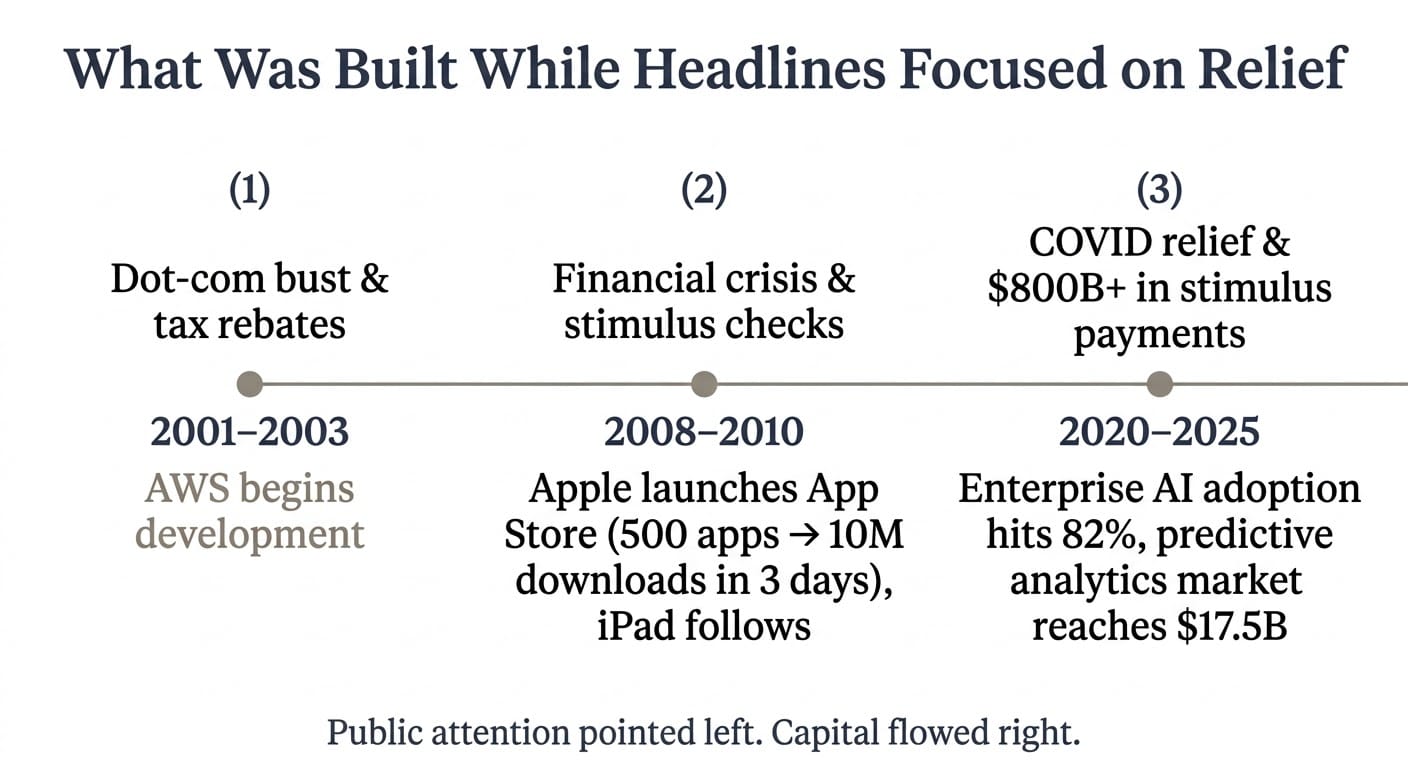
The same pattern repeated. Apple's Steve Jobs told Fortune in 2008 that Apple would "invest our way through the downturn" rather than cut headcount. While the economy contracted, Apple increased its R&D budget, launched the App Store in July 2008 with 500 apps, and watched users download 10 million applications in the first three days. Two years later came the iPad. Within a decade, the App Store ecosystem facilitated over $1.1 trillion in annual billings and sales.
These were not side stories. They were the main event—just not the one making headlines.
Why Stimulus Rarely Creates Wealth Cycles
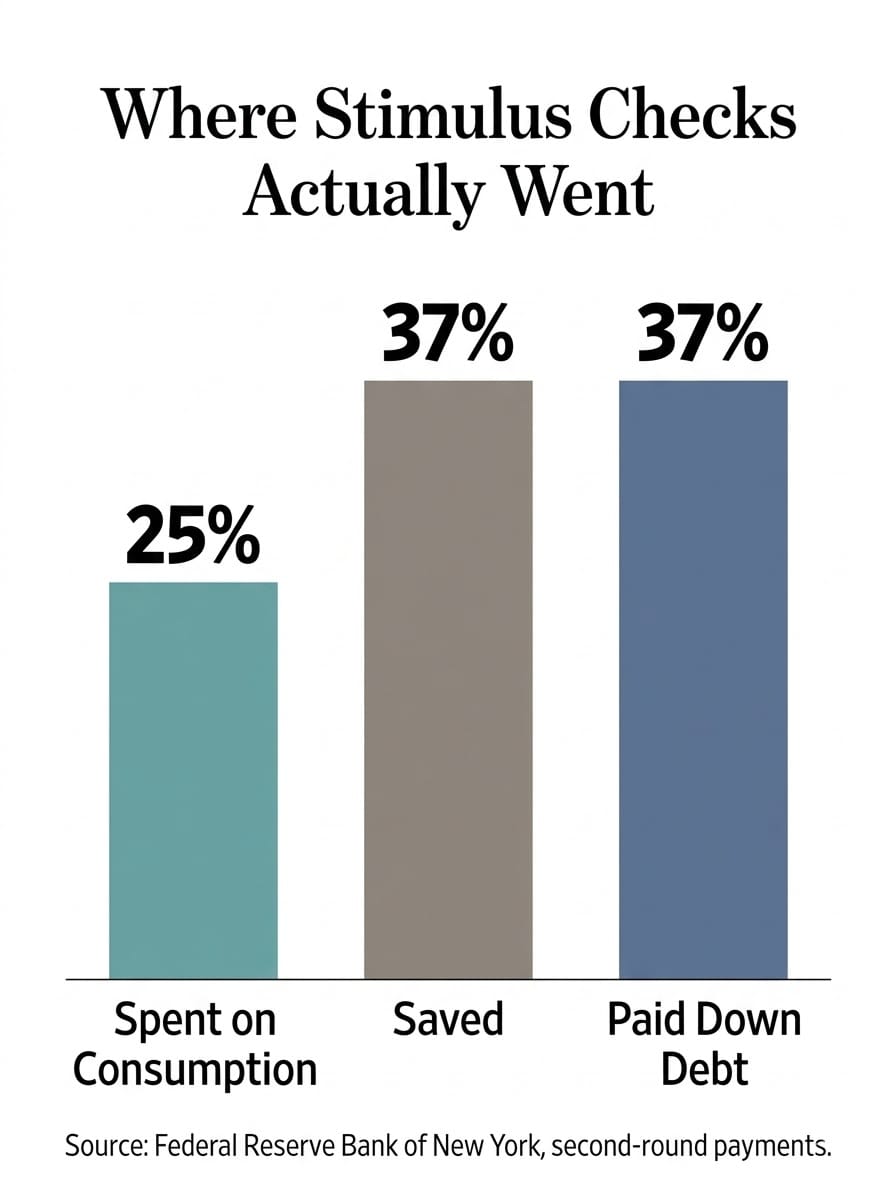
Federal stimulus checks serve a real purpose: economic relief during acute distress. Research from the Federal Reserve Bank of New York found that for the second round of COVID-era payments, respondents reported spending only about 25% of the total, while roughly 37% went to savings and 37% to paying down debt. A University of Chicago study reached similar conclusions—only about 15% of Americans reported spending most of their stimulus checks, with half using them to reduce debt.
This is not a failure of the policy. It is the policy working as designed—stabilization, not creation. Stimulus is a floor, not a foundation.
Wealth cycles require something different: durable productivity systems that compound over years, driven by infrastructure investment, not consumption support. The World Bank's own research concludes that if the goal is to "stimulate innovation as a basis for productivity gains and long-run growth, investing in foundational digital infrastructure may be more relevant."
The distinction matters because it changes where you look.
The New Productivity Layer
The infrastructure conversation today centers on AI—not as chatbots or content generators, but as predictive and decision systems embedded in enterprise operations.
The global predictive analytics market was valued at $17.49 billion in 2025 and is projected to reach $113.46 billion by 2035, growing at a compound annual rate of roughly 20.6%. Nearly 68% of large enterprises now deploy predictive analytics across multiple business functions, while about 61% integrate prescriptive analytics to optimize pricing, supply chain, and inventory decisions.
This is not hype-cycle adoption. Wharton's 2025 AI Adoption Report—its third annual wave—found that 82% of enterprise respondents now use generative AI at least weekly, 72% formally measure AI ROI, and three out of four leaders report positive returns on their AI investments. Spending increased 130% between 2023 and 2024, and 88% of leaders anticipate further budget increases in the next 12 months.
The shift is from exploration to accountability. That transition—from pilot to measured return—is the inflection point that separates speculative adoption from structural integration.
Temporary Relief vs. Structural Wealth Engines
| Temporary relief | Structural wealth engine |
|---|---|
| Stimulus checks distributed during crisis | Cloud infrastructure built during and after downturns nextplatform |
| ~25% of payments spent on consumption abcnews | AWS grew from $21M (2006) to a $20B+ run rate within a decade nextplatform |
| Relief targeted at stabilization and debt reduction dallasfed | Apple invested through the 2008 recession, launched App Store and iPad fortune |
| Short-term GDP boost, limited long-term multiplier nber | App Store ecosystem now facilitates $1.1T+ in annual commerce statista |
| Benefits dissipate within months pgpf | Predictive analytics market projected to grow from ~$17B to $113B over the next decade precedenceresearch |
| Public attention, political debate | Quiet capital formation, compounding returns |
Why Large Enterprises Adopt Predictive Systems
The enterprise case for AI-driven decision tools rests on measurable, repeatable returns—not aspiration.
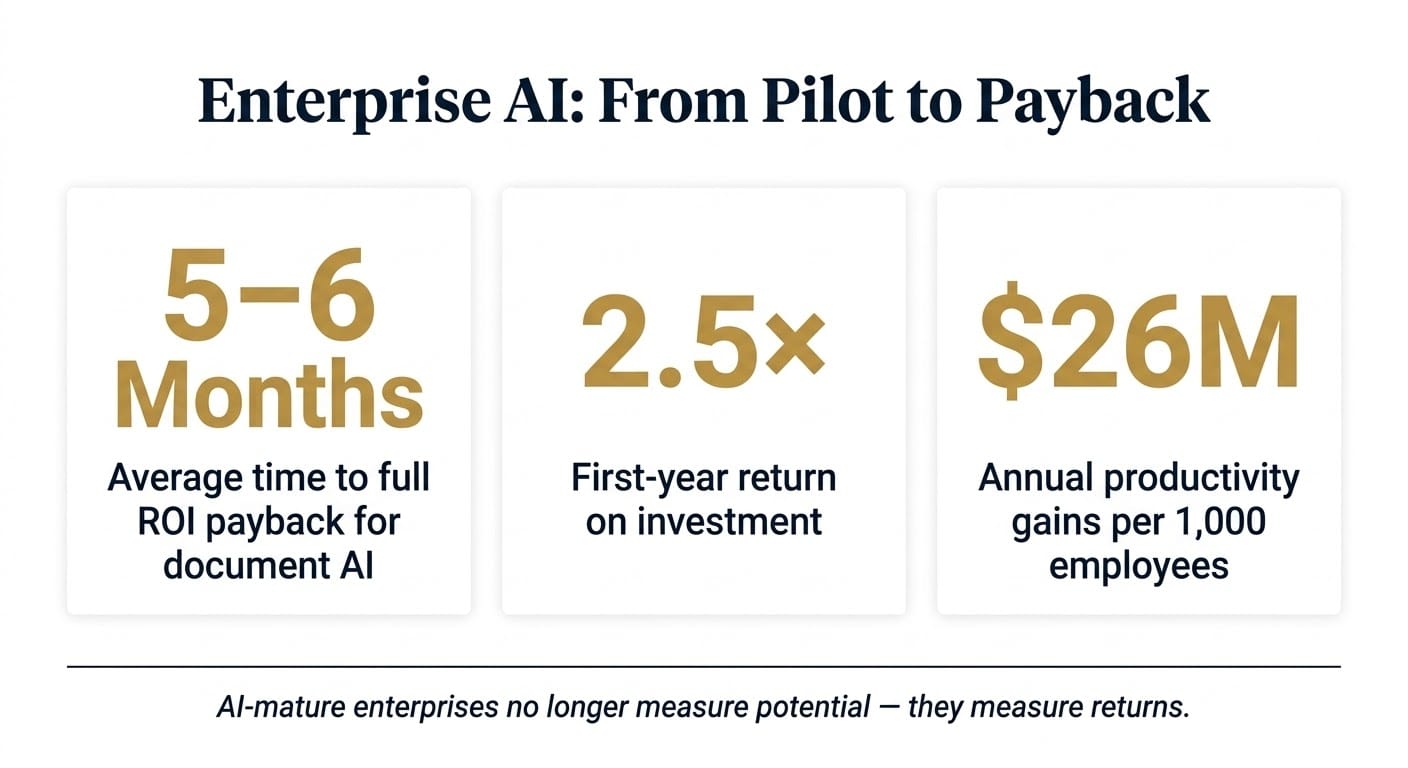
Document AI implementations, for instance, reach full ROI payback in five to six months, with an average return of 2.5x within the first year. For a 1,000-person company, annual productivity gains translate to roughly $26 million in recovered value at standard knowledge-worker rates.
The pattern scales across industries. Predictive pricing tools have helped companies like Lufthansa cut inventory costs by 18% and General Mills boost margins by 12% through AI-driven demand forecasting. Decision intelligence platforms—systems that combine predictive modeling with prescriptive recommendations—represent a market expected to grow from $16.3 billion in 2025 to $68.2 billion by 2035 at a 15.4% CAGR.
What makes these systems structural rather than cyclical is that they compound. Each decision loop generates data that improves the next prediction, creating an operational flywheel that deepens over time.
Everyone is talking about stimulus checks.
But they’re missing the real story.
Checks come and go — but major wealth cycles only appear once in a generation.
While the public debates payouts, insiders are preparing for the larger economic shift ahead — and many are turning toward assets that deliver predictable, data-driven performance.
RAD Intel’s AI platform is one of them.
With predictive intelligence built to generate measurable ROI (per SEC filings) for Fortune 1000 brands, RAD Intel is using this moment of economic transition to strengthen its position across commercial markets.
Its early-stage Reg A+ offering remains available at $0.85/share, with a Nasdaq ticker reserved as $RADI.
This is the kind of opportunity that compounds during moments of national reset.
Invest at $0.85/share.
Disclosure: Brand mentions reflect factual client work, past and present, and do not imply endorsement.This is a paid advertisement for RAD Intel made pursuant to Regulation A+ offering and involves risk, including the possible loss of principal. The valuation is set by the Company and there is currently no public market for the Company's Common Stock. Please read the offering circular and related risks at invest.radintel.ai
The Concept of Economic Reset
Every major productivity transition creates a window—brief, quiet, and largely invisible to the public conversation.
In the early 2000s, the window was cloud infrastructure. In 2008, it was mobile platforms. Today, it is the integration of AI decision systems into the operating layer of enterprise economics.
These windows share a common feature: they are open widest when public attention is directed elsewhere. The debate about checks and relief is important. But it tends to absorb the bandwidth that might otherwise be used to understand where the next structural layer of productivity is forming.
The Wharton researchers framing 2025 as "accountable acceleration" capture the dynamic precisely: AI investment is no longer experimental, but it is not yet fully priced into how most people think about economic opportunity. That gap between institutional adoption and public awareness is where structural advantage tends to accumulate.
Wealth cycles are not announced. They are not distributed in envelopes or debated on cable news.
They are built in server racks and data pipelines, in predictive models that shave basis points off logistics costs, in decision engines that compress planning cycles from weeks to hours. They are financed quietly, measured rigorously, and compounded slowly—until the gap between those who understood the infrastructure and those who watched the headlines becomes difficult to close.
The loud conversation will always attract more attention. The quiet one will always generate more value.
—
Claire West