The Quiet Math That Changes Everything
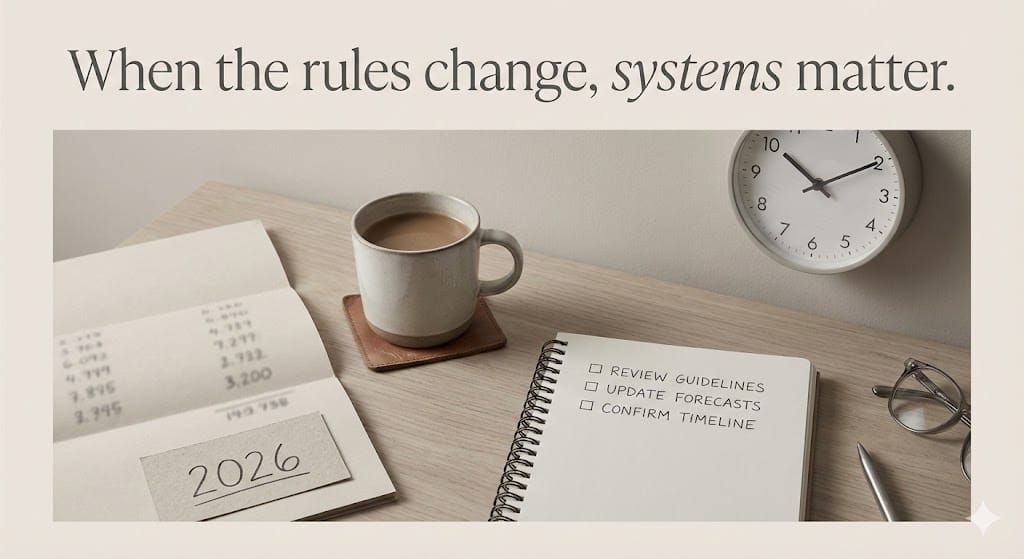
The email arrives in early December, buried in a pile of year-end statements. It's from your tax advisor, and the subject line says something neutral—"2026 Planning Update," perhaps, or "Standard Deduction Projection." You open it expecting boilerplate. Instead, you find a number: the standard deduction drops by roughly $2,000 next year. Just a number. No explanation. No urgency marker.
You stare at it longer than you should.
It's not a crisis. It's not news. It's mechanical. And that's precisely why it matters.
Most households will treat this as a minor adjustment—a CPP bracket shift, a tax table recalibration. But this particular change, arriving in January 2026, represents something larger: the expiration of the Tax Cuts and Jobs Act of 2017. And unlike a headline, unlike a policy debate, it will change the math of household finance in ways that feel invisible until they suddenly aren't.
This is the inflection point that quiet households are already preparing for. Not because they panic. Because they calculate.
What Actually Expires in 2026
The current standard deduction—the amount of income you can shield from federal taxation without itemizing—exists at historically elevated levels. For single filers, it sits at $14,600 in 2025. For married couples filing jointly, it's $29,200. These levels were set by the Tax Cuts and Jobs Act, and they were explicitly temporary. The law included a sunset clause. On January 1, 2026, unless Congress acts to extend them, these numbers fall.
The mechanical outcome is straightforward. For a single filer, the standard deduction drops to approximately $12,550—a loss of roughly $2,050 in tax-free income. For a married couple, the drop is closer to $3,600. This doesn't sound catastrophic in isolation. But taxation is a system. Small changes propagate.
If you earn $60,000 as a single filer and take the standard deduction, your taxable income falls to $45,400 (the old math). Next year, without legislative action, it becomes $47,450. The difference—roughly $2,050—gets taxed at your marginal rate. For someone in the 12% bracket, that's approximately $246 in additional federal tax per year.
For a household with $80,000 in combined income and $29,200 in deductions today, the expiration means $3,600 more in taxable income next year. In the 12% bracket, that's another $432 annually.
For households holding multiple income sources, living on fixed pensions, or managing annuity withdrawals, the cascade becomes more complex. A retired couple dependent on Social Security and a pension might find themselves pushed into a higher tax bracket not because their income grew, but because their tax shield contracted.
This is not melodrama. This is arithmetic.
Status: Critical for 2026.
On December 31, 2025, the key provisions of Public Law 115-97 (The Tax Cuts and Jobs Act) are scheduled to expire.
The result for January 1, 2026: The "Standard Deduction" is projected to be cut in roughly half.
While Washington debates, your tax exposure is about to widen. "Saving" is no longer a sufficient defense. You need an aggressive offense.
We are urging all retirees to review the "9:30 AM Income Offset" strategy immediately.
It is a method to target potential cash flow 3-5 times a week—specifically designed to help cover the gap created by the new tax reality.
Click here to review the 2026 Income Offset Plan.
Deadline: The laws change in a few weeks.
Why Saving Alone Stops Being Sufficient
The conversation around household finance typically splits into two camps: earn more or save more. These are the twin engines of financial stability. And they work—until tax mechanics change the ground beneath them.
Consider a household that has been disciplined about saving $8,000 annually into a retirement account. Over five years, that's $40,000 in contributions. The math feels solid. The behavior is reinforced by headlines about retirement readiness, compound growth, and the power of consistency.
But now layer in what happens in 2026. The standard deduction drops. Inflation—which has cooled from 2022 peaks but hasn't evaporated—continues to compress purchasing power. And the income withdrawn to support the household becomes subject to slightly higher taxation, not because policy changed in a dramatic way, but because the old rules expired.
The person saving $8,000 annually is making a bet that their future income will remain stable. Often, that's true. But the mathematics of taxation don't stay static. A household that saved consistently through 2025 might find their withdrawal strategy in retirement needs refinement starting in 2026, simply because the tax math shifted.
This is where the concept of "saving" as a defense mechanism begins to fail. Saving protects you against income shocks. It doesn't protect you against tax code mechanics. Those are separate systems.
Income Offsets: The Quieter Strategy
This is where discipline shifts from accumulation to timing.
An "income offset" is not a growth strategy. It's not about beating benchmarks or finding hidden returns. It's about gap coverage—the deliberate alignment of cash flow within windows where the tax math is most favorable.
Consider a retiree managing four income streams: Social Security ($24,000 annually), a pension ($18,000), portfolio withdrawals (varies), and part-time work ($4,000). Their total income is substantial, but it's fragmented across sources that trigger different tax treatment.
Traditional advice says: retire, live on fixed income, minimize withdrawals. The mental model is conservative and safe.
But the offset model asks different questions. Which of these income sources can be repositioned within the calendar year? Can portfolio withdrawals be clustered in months when other income is naturally lower? Can part-time work be shifted to years with larger charitable contributions (which would be itemized rather than taking the standard deduction)? Which sources trigger taxation of Social Security benefits?
None of these strategies grow wealth. They simply reduce the tax friction on existing income. For a household with $46,000 in annual income, optimizing the timing of withdrawals might save $400 to $800 annually. Over a 25-year retirement, that's $10,000 to $20,000—not spectacular, but meaningful, and earned through structure rather than risk.
The offset approach becomes more valuable in 2026 precisely because the standard deduction shrinks. The gap between optimized and unoptimized tax treatment widens.
Time-Based Windows and the Psychology of Certainty
This is perhaps the most underrated concept in financial planning: people prefer short, repeatable windows to long-term promises.
A household can commit to reviewing their tax position annually. They can mark January—or better, late November—as their planning season. They can design a routine. The window feels manageable because it happens every year. The rules might change, but the process remains constant.
By contrast, a commitment to "save for retirement in 2050" is abstract. The rules will almost certainly change. Life events intervene. The timeline feels distant and uncertain.
Some financial professionals now use what's called an "income window" framework—a specific quarterly or annual period optimized for rebalancing, tax harvesting, or withdrawal sequencing. The window is short (weeks, not years). The purpose is narrowly defined. The calendar constrains expectations.
A professional might plan a household's cash flow around Q4 and January specifically because those months offer the most flexibility for tax optimization. They don't promise better returns. They promise better structure and more predictable outcomes.
This framework becomes especially relevant in 2026 because the standard deduction change creates an anchor point. Professionals can build planning routines around it. Households can prepare in advance. The uncertainty shrinks.
Traditional Retirement Thinking vs. Income Offset Thinking
| Dimension | Traditional Approach | Income Offset Approach |
|---|---|---|
| Primary Goal | Maximize accumulated assets | Optimize cash flow within tax framework |
| Risk Focus | Market volatility, longevity risk | Tax bracket progression, rule changes |
| Planning Horizon | 20–40 years | 1–5 years with ongoing reviews |
| Income Treatment | Minimize withdrawals, let accounts grow | Sequence withdrawals strategically by source |
| Tax Strategy | Standard deduction, annual tax preparation | Quarterly reviews, timing adjustments |
| Adaptation Speed | Slow; rebalancing annually | Fast; responsive to rule changes within calendar year |
| Psychological Anchor | "How much do I need?" | "When should I take it?" |
| 2026 Impact | Standard deduction drop feels sudden | Incorporated into existing planning cycle |
The offset model is not superior—it's different. It suits households with multiple income sources, those approaching or in retirement, and anyone navigating periods when tax rules are in flux. It requires more attention than set-it-and-forget-it savings, but it delivers something that passive strategies can't: responsiveness.
Why Intelligent Households Delay Until Rules Crystallize
There's a quiet phenomenon in financial planning: households often wait for tax law changes to stabilize before adjusting behavior significantly. It feels like procrastination. Often, it's actually rationality.
If Congress extends the higher standard deduction past 2026, any planning done in 2025 becomes partially obsolete. If Congress lets it expire and makes additional changes, the window might shift again. Until the rules crystallize, detailed planning contains a high degree of wasted effort.
This is not passivity. It's recognition that some decisions become clearer once the environment becomes more stable.
What households can do now: examine income sources, understand which ones trigger taxation of benefits, review whether itemizing might become valuable in 2026 or beyond, and establish a planning routine rather than waiting for a crisis to plan.
Some financial professionals now teach a framework called the "income sequencing window"—a method of ordering withdrawals across multiple sources to minimize tax friction within a given year. A free guide available through structured financial education explains how the framework works and why some households approaching or in retirement are studying it before the 2026 standard deduction change takes effect.
Systems, Surprise, and Dignity
The expiration of the Tax Cuts and Jobs Act is not a political moment requiring outrage or activism. It's a structural moment requiring preparation.
Preparation is not panic. Panic happens when events surprise you. Preparation means you've already anticipated the event and designed a response. The difference is psychological, but it compounds. A household that plans for the 2026 standard deduction change will experience it as an adjustment. A household that ignores it will experience it as a loss.
This is the core insight that separates mechanical thinking from reactive thinking. Tax code changes don't remove risk. They reorganize it. But households that stay mentally ahead of those shifts reduce the portion of risk that feels like surprise.
The work for the next few months is quiet. It's spreadsheets, not headlines. It's understanding your income sources, not predicting markets. It's building a repeatable process, not making one heroic decision.
That's not glamorous. But it's how time-steady households prepare for inflection points. And 2026 is undeniably one.
—
Claire West