The Quiet Race to Reinvent Energy: Why a $65B Megaproject Might Lose to a Tiny U.S. Startup
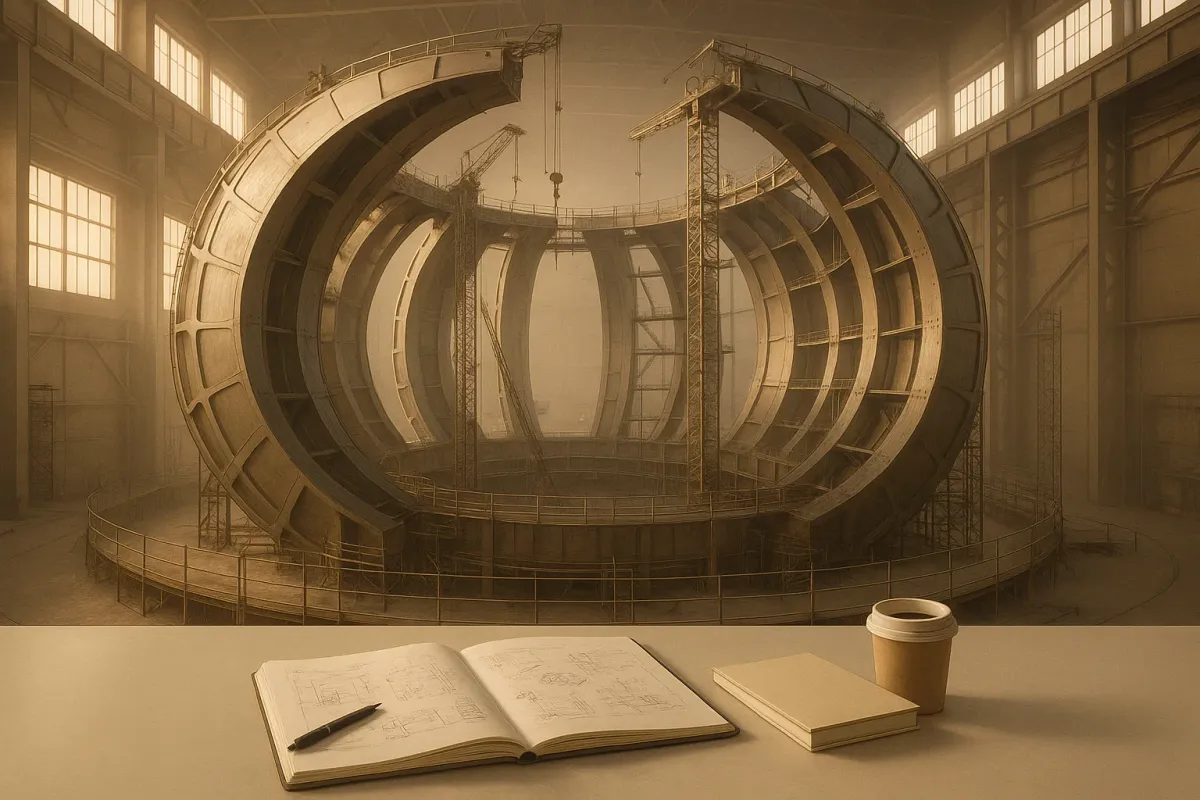
Will the largest international science experiment in history change the world forever – or fizzle out before it even goes live?
It will cost $65 BILLION…
Weigh as much as three Eiffel towers…
And potentially generate clean, virtually limitless energy by 2035.
But by the time this machine comes online, it could already be obsolete.
That's because a tiny Massachusetts startup is building a version of this machine that will cost 99% less to build – and potentially come online a whopping eight years before it.
Bill Gates says it "could be as transformative as the invention of the steam engine before the Industrial Revolution."
And Bloomberg projects that it could have a bigger economic impact than AI, crypto, and quantum computing COMBINED.
No wonder Jeff Bezos, Nvidia, Google, and more are backing this small firm.
Now it's your turn.
Southern France, early morning. The construction site stretches across 180 hectares—three times the size of the Pentagon. Steel frames rise like cathedral spires, cranes pivot in slow arcs, and thousands of workers move through corridors of scaffolding that will eventually house the most expensive science experiment ever built.
This is ITER—the International Thermonuclear Experimental Reactor. Thirty-five nations pooled resources. Sixty-five billion dollars committed. A fusion machine designed to prove that humanity can harness the power of stars.
But 5,000 miles away, in a nondescript industrial park outside Boston, a team of forty engineers is building something smaller, faster, and potentially more disruptive: a fusion reactor the size of a shipping container that could render ITER obsolete before it ever turns on.
This is the quiet race to reinvent energy. And the outcome may determine who controls the global economy for the next century.
The $65B Bet
ITER isn't just a reactor. It's a monument to international cooperation and scientific ambition. The machine's core—a tokamak—weighs as much as three Eiffel Towers. Its superconducting magnets require temperatures colder than deep space to operate. And when complete, it will attempt to sustain a fusion reaction hot enough to replicate the sun's core: 150 million degrees Celsius.
The timeline: full operation by 2035, if nothing else goes wrong. The goal: prove that fusion can produce more energy than it consumes, paving the way for commercial reactors in the 2050s.
The scale is staggering. The engineering, unprecedented. And the political coordination required to keep 35 nations aligned across decades of delays and cost overruns—nearly impossible.
Which is why some analysts quietly question whether ITER, however brilliant, will ever fulfill its promise.
Back in 2018, when Jeff Brown told everyone to buy Tesla…
The "experts" said Elon was finished and Tesla was headed for bankruptcy.
Now they're saying the same thing, but Jeff has uncovered Tesla's next breakthrough.
The Problem Nobody Wants to Admit
ITER was designed in the 1980s. Construction began in 2007. First plasma—the initial test run—is now scheduled for 2035, nearly three decades after groundbreaking.
The delays aren't just bureaucratic. They're structural. When you build a machine this complex with components manufactured across six continents, every design change requires international approval. Every supply chain disruption cascades. Every political tension threatens funding.
And beneath the engineering challenges lies a deeper concern: what if ITER succeeds, but by the time it does, the technology is already obsolete?
Fusion research has accelerated dramatically in the past decade. Private companies, freed from international committees and procurement timelines, are iterating faster. Testing bolder designs. And reaching milestones ITER won't attempt for years—using machines a fraction of the size and cost.
The risk isn't that ITER fails. It's that it succeeds too late.
The Disruption Nobody Saw Coming
Commonwealth Fusion Systems. A startup spun out of MIT in 2018. Forty engineers. A prototype reactor called SPARC, roughly the size of a tennis court—99% smaller than ITER by volume.
Their timeline: first plasma by 2027. Commercial demonstration by the early 2030s. Eight years ahead of ITER, at a fraction of the cost.
How? High-temperature superconducting magnets. The breakthrough that makes everything else possible. Traditional tokamaks require massive machines to generate the magnetic fields needed to confine fusion plasma. Commonwealth's magnets—developed over the past decade—generate stronger fields in far smaller packages, compressing the entire reactor into a space that fits inside an industrial warehouse.
This isn't incremental improvement. It's architectural disruption—the kind that makes legacy infrastructure irrelevant before it's even finished.
The Physics Behind the Promise
Fusion works by forcing hydrogen atoms together with such intensity that they merge, releasing energy in the process. The challenge: hydrogen nuclei repel each other with immense force. Overcoming that repulsion requires extreme heat and confinement.
Traditional tokamaks use magnetic fields to contain the plasma—a superheated gas where fusion occurs. But generating fields strong enough to hold plasma at 150 million degrees requires either enormous machines (ITER) or better magnets (Commonwealth).
High-temperature superconductors—magnets that operate at relatively "warm" temperatures (still cryogenic, but manageable)—changed the equation. They produce fields 2-3 times stronger than conventional superconductors, meaning smaller reactors can achieve the same confinement.
The result: fusion machines that fit in buildings instead of requiring dedicated industrial complexes. That cost hundreds of millions instead of tens of billions. And that can be iterated, tested, and commercialized on timelines measured in years, not decades.
In 2023, Biden’s FDA rejected Elon Musk’s application to start human trials on his life-changing Neurolink project…
But now in 2025, the tables have turned.
He and his DOGE team are now targeting waste and fraud inside the FDA…
And the top brass is TERRIFIED.
He’ll likely gain access to everything he needs to reveal the FDA’s biggest secret.
It involves a hushed-up alliance with Big Pharma, as well as hundreds-of-billions in profits.
And DOGE is on the verge of bringing the entire house of cards crashing to the ground.
But liberals and Big Pharma won’t let THIS be revealed without a fight.
Which is exactly why we’re not waiting around…
Why Big Tech Is Betting Early
Bill Gates. Jeff Bezos. Vinod Khosla. Google . NVIDIA . All have invested in Commonwealth Fusion or similar ventures.
Why? Because they understand that energy is infrastructure—the foundation beneath every other technology. AI demands enormous computational power. Data centers consume gigawatts. Electric vehicles require grid capacity that doesn't exist yet. And all of it depends on energy sources that scale, decarbonize, and cost less than fossil fuels.
Fusion offers that trifecta. Limitless fuel (hydrogen from seawater). Zero carbon emissions. Energy density that makes solar and wind look incremental. The investor thesis isn't about fusion as a novelty—it's about fusion as the substrate for the next industrial era.
Those who control fusion infrastructure early won't just profit. They'll shape the energy economy for decades.
The Economics
| Factor | ITER (Large-Scale) | Commonwealth SPARC (Compact) |
|---|---|---|
| Cost | $65 billion+ | ~$2 billion (estimated) |
| Timeline | First plasma 2035 | First plasma 2027 |
| Output | 500 MW (experimental) | 140 MW (demo), scalable |
| Physical Size | 180-hectare facility | Warehouse-scale |
| Risk | Political, bureaucratic, technical | Technical, capital |
| Commercial Path | 2050s or beyond | Early 2030s |
This table isn't advocacy. It's structure. ITER remains essential for fundamental science—proving fusion at unprecedented scale. But Commonwealth's approach offers a faster path to commercial deployment, which matters more for investors, utilities, and governments trying to decarbonize within decades, not generations.
What a 2030s Fusion Breakthrough Means for Households
If compact fusion scales commercially by the mid-2030s, the implications cascade:
Energy costs decline. Fusion's fuel—hydrogen isotopes—is effectively limitless. Once capital costs are amortized, operational costs drop toward near-zero marginal pricing. Electricity becomes cheaper, more abundant, more reliable.
Grid independence accelerates. Small-scale fusion reactors could power industrial facilities, data centers, or even neighborhoods independently—reducing reliance on centralized utilities and vulnerable transmission infrastructure.
Geopolitics shift. Nations dependent on oil imports gain energy sovereignty. The petrodollar weakens. And energy, once a strategic commodity, becomes a manufacturing challenge—favoring nations with advanced engineering over those with natural resources.
For households, this doesn't mean free energy. But it does mean downward pressure on costs, increased resilience, and reduced exposure to energy price volatility.
The American Edge
Fusion isn't uniquely American. China, the EU, and private ventures globally are racing toward the same goal. But the U.S. currently leads in compact fusion innovation—largely due to private capital, university-industry collaboration, and regulatory frameworks that allow rapid iteration.
Commonwealth, TAE Technologies, Helion Energy—all U.S.-based, all well-funded, all targeting commercial deployment within a decade. If they succeed, the economic benefits accrue domestically first: jobs, manufacturing, energy security, and export opportunities as the technology matures.
This isn't nationalism. It's industrial positioning. The nations that dominate fusion infrastructure early will shape global energy markets the way oil-producing nations shaped the 20th century. And right now, the U.S. holds the early advantage—if it can sustain investment and avoid regulatory paralysis.

Wall Street legend who called the dot-com crash, the 2008 financial crisis,
and the COVID-19 market rebound exposes..."Amazon Helios"
Stansberry Research
I think often about the steam engine. Not the industrial behemoths that powered factories and railways, but the first ones—small, inefficient, dismissed by skeptics who couldn't imagine how quickly iteration would transform novelty into dominance.
ITER is magnificent. A triumph of coordination and engineering. But history suggests that transformations don't come from consensus projects built by committees. They come from small teams, working faster, risking more, and iterating until the architecture shifts.
Fusion may not arrive as a singular breakthrough. It may arrive quietly—one compact reactor at a time, powering a data center here, a factory there, until the grid itself becomes optional and energy costs decline not through policy, but through physics.
The race isn't over. But the quiet competitors—the ones building shipping-container reactors in Massachusetts warehouses—may cross the finish line first. And when they do, the $65 billion monument in France will remain what it always was: a proof of concept, rendered obsolete by the future it helped inspire.
—
Claire West