The Rise of Predictive AI in Finance — And What It Really Means for Everyday Investors
5:47 a.m. Coffee still brewing. The house quiet except for the hum of the refrigerator and the soft glow of three monitors on my desk. I've developed this habit over the years—reviewing market dashboards before sunrise, when the overnight session data settles and the pre-market patterns begin to form.
This morning, something caught my attention. A sharp move in futures—precise, rapid, coordinated—that reversed within minutes, as if testing a level and retreating with mechanical efficiency. Then another. And another. No headline triggered it. No earnings report justified it. Just movement that felt less like human decision-making and more like something else entirely.
I've watched markets for decades. I know what fear looks like in price action. I know what greed looks like when it overextends. But this was different—faster, cleaner, almost surgical. The kind of pattern that emerges when machines talk to machines, and humans watch from the sidelines trying to make sense of the conversation.
The Shift No One Prepared For
Markets have always moved on human behavior. Fear and greed. Hope and panic. The cycles that repeat because psychology repeats—because we are, fundamentally, predictable in our collective irrationality.
But something changed.
Over the past decade, AI-driven systems have become embedded in every layer of market infrastructure. Not just high-frequency trading—that's old news. But predictive detection systems that analyze order flow, sentiment, volatility clusters, and cross-asset correlations in real time. Systems that don't just react to prices, but anticipate where prices are going based on patterns invisible to the human eye.
These systems now influence intraday price direction. They front-run momentum. They detect accumulation before it becomes visible. And they operate at speeds measured in microseconds—faster than any human can perceive, let alone respond to.
This isn't conspiracy. It's infrastructure. The market you see on your screen is increasingly a surface-level representation of a much deeper, faster, more algorithmic reality.
Why Prediction Became Possible
Let me be clear: these systems don't see the future. They're not magic. They're not omniscient. But they do something humans cannot—they process vast quantities of data simultaneously and detect patterns that precede visible moves.
Three concepts matter here:
Pattern clustering: Markets generate enormous data—price, volume, order flow, options activity, news sentiment, social media mentions. AI systems cluster this data, identifying configurations that historically preceded specific outcomes. Not certainty. Probability.
Anomaly detection: When something deviates from normal—unusual volume, unexpected correlation breaks, sudden options positioning—the system flags it. These anomalies often signal pressure building before the move becomes obvious.
Algorithmic feedback loops: When multiple AI systems detect similar signals, they act. That action creates price movement, which other systems detect, which triggers more action. The result: self-reinforcing moves that accelerate faster than traditional analysis can explain.
The key insight: these systems detect pressure building before humans notice. By the time you see the breakout or breakdown on your chart, the machines that anticipated it have already positioned.
An AI created by a former top-secret Air Force nuclear missile coder has now learned to forecast the direction of the U.S. stock market.
Early users could have already tripled their money, based on the average winning trades this AI has spotted so far.
It's impossible to say how long this could stay effective... so I wanted to bring it to your attention right away.
I believe you could rapidly triple your entire net worth or more – if you take advantage of this AI now... while it's still helping issue rapid calls.
Because this is urgent...
I've secured a way for you to test this AI for your own portfolio, right away, for free – NO email and NO credit card needed.
The Vulnerability of the Individual Investor
I think about this often—how it feels to be a regular investor in a market that moves at machine speed.
There's a quiet frustration many people carry. The sense of being perpetually one step behind. You see a move, react, and by the time your order fills, the opportunity has shifted. You read analysis, form a thesis, and the market seems to have already priced in what you just discovered.
It's not your fault. You're not slow. You're just human in a market increasingly shaped by systems that don't sleep, don't hesitate, and don't feel uncertainty.
But here's what I've learned: the answer isn't to compete with machines on speed. It's to understand the landscape they're creating and find ways to align with it rather than fight it. The individual investor's advantage isn't velocity—it's patience, selectivity, and the willingness to use tools that level the playing field.
The New Landscape: AI vs. Human Instinct
The contrast is stark:
Human intuition: Valuable, but delayed. By the time you "feel" something is wrong, the move is often underway. Gut instinct evolved for physical danger, not algorithmic markets.
Machine inference: Instantaneous. Pattern detected, probability calculated, position executed—all in fractions of a second. No emotion. No hesitation. No second-guessing.
News as indicator: Increasingly lagging. By the time headlines hit your feed, the systems monitoring news wires, social sentiment, and order flow have already acted. You're reading the effect, not the cause.
This is the 2025 landscape: volatility amplified by algorithmic feedback, rate pivots creating cross-asset dislocations, geopolitical tensions generating sentiment shifts that machines detect before analysts write about them.
The question isn't whether AI has changed markets. It has. The question is how you adapt your approach to a reality where information moves faster than human cognition.
A Different Kind of Tool
I've become increasingly interested in systems that don't try to replace human judgment but augment it—tools that process what we can't, flag what we'd miss, and compress the detection gap between machine speed and human decision-making.
A former Air Force nuclear-missile coder built an AI that has now learned to forecast short-term market direction. Early users reportedly saw triple-digit average gains on its winning trades—and the tool is currently available to test for free, no email and no credit card.
I mention this not as endorsement, but as example. The landscape is shifting. Tools that were once available only to institutions—pattern detection, anomaly flagging, probability modeling—are becoming accessible to individual investors. The asymmetry that favored the few is eroding, slowly, as technology democratizes what was once gatekept.
Whether this particular tool suits your approach is personal. But the broader point matters: the toolkit is expanding, and those who ignore it may find themselves increasingly disadvantaged in markets shaped by systems they don't understand.
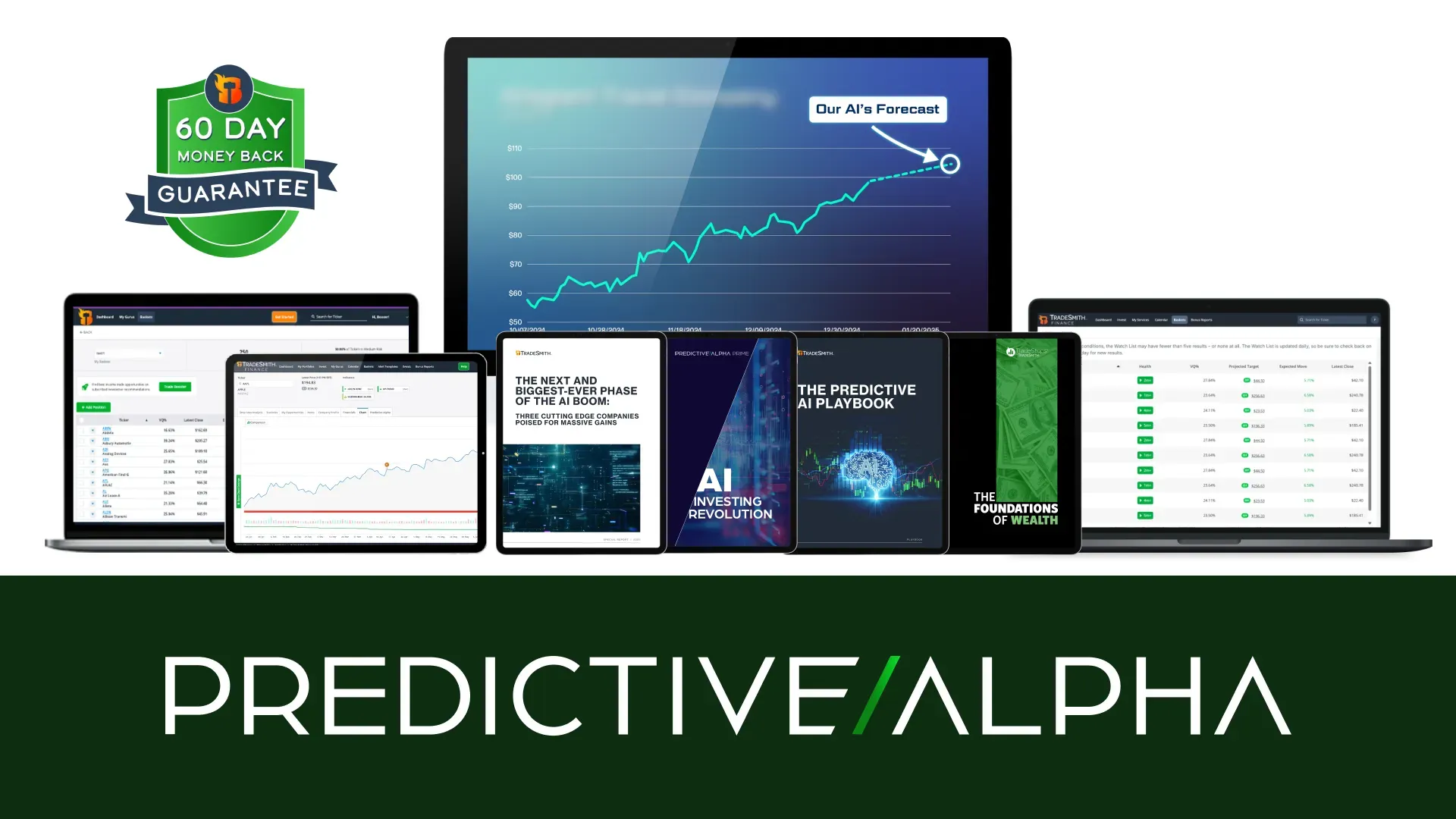
Same AI Tech That Predicts Grid Blackouts and Heart Failure... Now Gives You the Chance to Outperform 99% of Money Managers
TradeSmith
I step back from the monitors as the sun finally rises. The pre-market patterns have settled into something resembling normalcy—or at least the appearance of it.
What strikes me most about the AI transformation in finance isn't the speed or the sophistication. It's the responsibility it places on us as individual participants.
Technology doesn't replace our judgment. It expands our toolkit. But a toolkit is only as good as the person using it. AI can detect patterns, flag anomalies, and compress information—but it can't tell you what matters to you, what risk you can tolerate, or what timeline fits your life.
That remains human. That remains yours.
The investors who thrive in this landscape won't be those who blindly follow signals or chase every algorithmic edge. They'll be those who understand what the tools are doing, integrate that understanding into their own framework, and maintain the discipline to act on systems rather than impulses.
Markets have always rewarded those who understood the game being played—not the game they wished existed, but the one actually unfolding.
Today, that game includes AI-driven detection, algorithmic feedback loops, and information flows moving at speeds incomprehensible to human cognition. You can ignore this reality, or you can acknowledge it and adapt.
The point isn't to become a machine. It's to understand the landscape machines are creating, find tools that compress the gap between their speed and your decision-making, and remember that no system replaces the fundamentals: risk management, position sizing, emotional discipline, and clarity about why you're in the market at all.
Think in systems, not impulses. Understand the new landscape before you try to navigate it. And remember that the best investors in any era aren't those who fight the market's evolution—they're those who learn its rhythms and position accordingly.
The sun is fully up now. Another day. Another opportunity to observe, adapt, and act with intention.
—
Claire West