The Signal We Weren’t Supposed to Ignore
It never arrives with fireworks.
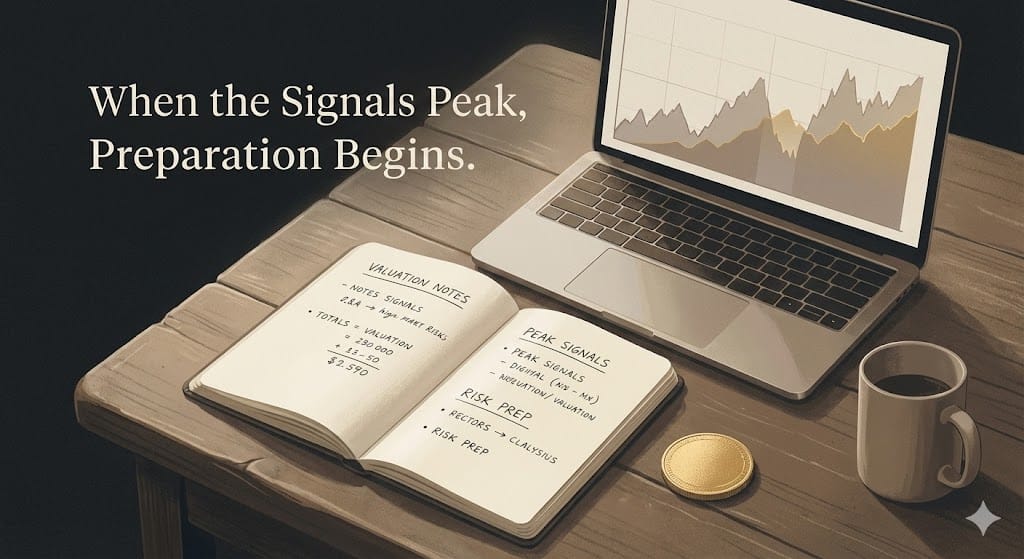
Most of the time, the “warning sign” is just a number on a screen, buried in a dashboard that only a certain kind of person checks before bed. That was the case tonight: a quiet room, a dim lamp, a laptop screen showing a chart that looked less like finance and more like altitude.
Market cap to GDP — the so‑called Buffett Indicator — nudging above 210%.
No alarms. No breaking news banner. Just a single ratio saying, in its own unemotional way: we are far from shore.
Every market era has one unmistakable signal that later generations point to and say, “It was obvious.” In 1999, it was price-to-sales on dot-coms with no revenue. In 2007, it was anyone with a pulse qualifying for a mortgage. Today, it might be this: markets priced so far above the productive capacity of the real economy that the chart looks like a cliff face.
Most people will ignore it. They’ll lean on narratives: “This time is different.” “The Fed won’t allow a crash.” “Tech has changed the rules.” Those phrases always float around near peaks like a kind of soft anesthesia.
But the signal is still there, glowing quietly in the corner of the screen.
The Overvaluation Problem
Long bull markets distort perception.
At first, people are cautious. After a crash, every rally feels fragile. Valuations look stretched at levels that, in hindsight, seem conservative. But as the bull market grinds on—five years, ten years—what once felt extreme starts to feel normal.
Price-to-earnings ratios step up. Price-to-sales no longer raises eyebrows. The Buffett Indicator climbs above 150%, then 180%, then 200%. Each time, someone writes a thoughtful article explaining why this time isn’t like the last time.
Overvaluation isn’t just a mathematical condition. It becomes cultural. It’s in the way people talk about their 401(k)s at dinner. It’s in the way financial television treats every dip as a “buying opportunity” instead of a warning shot. It’s in the quiet assumption that stocks, given enough time, only really go one direction.
At a Buffett Indicator above 210%, the message isn’t “a crash is imminent.” Ratios don’t have clocks. The message is simpler, and more uncomfortable:
From this altitude, future returns are constrained. There’s less room for error. Less margin for disappointment. And the first people to feel that squeeze are not hedge funds or venture capitalists.
They’re regular savers.
Why Overvaluation Hurts Regular Savers First
If you’re 25 and markets drop 40%, it’s a story you tell later. You have decades to recover. Your future contributions buy cheaper shares. Volatility hurts, but it doesn’t define your financial life.
If you’re 55 or 60, the equation changes.
This is where sequence-of-returns risk stops being a textbook concept and becomes deeply personal. A bad decade near retirement doesn’t just reduce returns — it reshapes your entire plan:
Portfolio withdrawal rates suddenly look aggressive, not conservative.
The “early retirement” window quietly closes.
Part-time work shifts from optional to necessary.
Overvaluation matters most to the people with the least time to wait for reversion.
When valuations are stretched, volatility isn’t just an abstract risk. It’s a threat to timing — the one variable late‑career savers can’t easily adjust. You can change your allocation. You can trim spending. You can delay Social Security.
What you can’t do is rewind a decade of buying at the top.
U.S. markets are more overvalued than ever in history.
The Buffett Indicator sits above 210%, signaling extreme risk to anyone holding paper assets.Tech stocks, AI hype, and runaway printing have created the perfect storm.
Buffett is sitting on $330 billion in cash and preparing to move into gold — his historical safe haven.
Every previous market peak has proven that gold outperforms everything else during the next decade.
Final confirmation of my prediction could come by February 17th — when Buffett’s 13F filing hits the tape.You want to be in position before that happens.
Go here to get the name and ticker of Buffett’s next big gold move.
These small-cap miners have the potential to deliver 100X returns.
Protect your wealth while others are left holding overvalued paper assets.
The Pattern: Every Peak Has a Safe-Haven Countermove
Markets don’t fall in isolation. Capital always looks for somewhere to go.
Historically, when equity valuations sit at rarefied levels and then begin to unwind, certain “safe haven” assets tend to move in the opposite direction—not perfectly, not instantly, but meaningfully over time.
In the 1970s, as inflation eroded real returns on stocks and bonds, gold stepped into a different role. It didn’t behave like an investment as much as a protest against a system people no longer fully trusted.
From 2000 to roughly 2011, as the tech bubble deflated and then the financial crisis hit, equity markets went through a lost decade. Broad indices moved sideways in real terms. Meanwhile, gold quietly climbed from the low $200s to over $1,800 at its peak.
No promises. No guarantees. Just context: in periods where confidence in paper claims wavers—whether due to inflation, overvaluation, or systemic stress—capital often rotates toward tangible stores of value, not because they’re exciting, but because they feel less imaginary.
It’s not a mirror image. It’s more like a tide: slow, cumulative, easy to miss if you’re only watching daily closes.
The Buffett Contrast: Cash, Patience, and Timing
Then there’s Warren Buffett , the man whose name is attached to the very indicator flashing red.
Berkshire’s cash pile—recent estimates place it near $330 billion—has become its own kind of market commentary. Not a prediction, not a sermon. Just a stance.
Holding that much cash at this level of overvaluation says something quietly powerful:
“I don’t like the prices I see.”
“I’m willing to wait.”
“I value optionality more than participation right now.”
For regular investors, the lesson isn’t “copy Buffett’s trades.” It’s to pay attention to his patience. Cash, in this context, isn’t laziness. It’s potential energy. It’s a refusal to pay any price just to stay fully invested.
In a culture that treats sitting still as failure, that’s a hard posture to adopt. But it’s also one of the few tools ordinary investors have to protect themselves from the psychological pressure of long bull markets: the pressure to chase, to keep up, to stay “all in” because everyone else is.
What Happens When Cash Looks for Shelter
Cash doesn’t stay idle forever.
When multiples compress, when reality starts to reassert itself, when investors decide they’re no longer comfortable paying 30, 40, 50 times earnings for growth stories, capital goes hunting for shelter.
Sometimes it goes into traditional defensives: utilities, healthcare, consumer staples. Sometimes it goes into short-term Treasuries, trading return for liquidity and perceived safety.
And sometimes, especially when the concern isn’t just valuation but currency and system risk, it moves into real assets: land, infrastructure, and yes, precious metals.
Gold often moves first. Mining stocks—the businesses that pull metal out of the ground—tend to lag:
At first, they underperform because investors don’t believe the move.
Then, as higher spot prices begin to flow through into margins and earnings, a second stage begins: repricing.
Miners, which looked like dead money when gold was cheap, suddenly look like leveraged plays on a metal the market has already decided to value more highly.
This isn’t a forecast. It’s a pattern observed across multiple cycles: first the metal, then the businesses behind it.
The February 17 Moment
Dates don’t mean much until they do.
In professional circles, 13F filing deadlines—those quarterly snapshots of what large institutional investors hold—have become their own kind of ritual. Not because they reveal secrets, but because they provide a cultural timestamp: this is what the big money wanted to own three months ago.
Think of “February 17” (or whatever date the next 13F batch appears) less as breaking news and more as a delayed reflection. By the time a headline shouts “Buffett buys X” or “Hedge funds rotate into Y,” the positioning is already in place.
Ordinary investors, understandably, often move on that lagged information. They wait for confirmation in the form of a story: a segment on financial TV, a chart annotated with arrows, a talking head explaining what the filings “mean.”
The problem is timing. Headlines arrive after the decision. They’re useful for understanding sentiment. They’re less useful for capturing the earliest, most asymmetric part of a move.
Treating 13Fs as cultural events—signals of what the market believes about itself—can be helpful. Treating them as trading instructions is where many get hurt.
What Stability Really Means
Stability is a comforting word, but it’s often misunderstood.
To many, stability means “no losses,” “no volatility,” “no surprises.” But markets don’t function that way. Economies don’t either. Trying to avoid all risk usually leads to a different, quieter risk: erosion—of purchasing power, of opportunity, of flexibility.
In Claire’s lens, stability doesn’t mean avoiding risk. It means understanding where the system is likely to bend first, and deciding consciously how much of that stress you want to carry.
In an overvalued market:
Stocks may bend first through multiple compression.
Bonds may bend through inflation and real yield shifts.
Currencies may bend through policy choices that trade short-term relief for long-term devaluation.
Stability, then, becomes less about clinging to any one asset and more about diversifying where and how those bends affect you. Some exposure to paper claims. Some to hard assets. Some to cash that can pivot when prices make more sense.
Not because any of these are magic. But because spreading your exposure across how different things break is one of the few ways to remain standing when something finally does.
A Quiet Resource for a Loud Environment
Some people, understandably, want more detail about the “second-tier” players in this dynamic—the ones that don’t make headlines but may feel the impacts of rotation most acutely.
Analyst Garrett Goggin has released a brief outlining the small-cap miners he believes could respond most dramatically if Buffett rotates into gold. His report also includes the name and ticker of the company he calls Buffett’s “next big gold move.” You can read his brief here.
Whether you act on that information or not, resources like this can serve a quieter purpose: helping you understand the architecture behind the stories, not just the stories themselves.

In the end, no one knows how this plays out.
Maybe valuations drift sideways while earnings catch up. Maybe we get a sharp repricing followed by a slow rebuild. Maybe policy interventions stretch this era longer than anyone thinks possible.
You don’t need to know which path is right to act responsibly. You don’t need to predict the exact month a market peak will be recognized in hindsight. You don’t need to chase every hedge fund move or every gold rumor.
What you do need is honesty:
About where we are in the cycle.
About how much volatility your stage of life can realistically absorb.
About what “stability” means for you—not in theory, but in dollars, in years, in sleep.
Preparation, at its best, is a quiet act. It doesn’t look dramatic. It looks like trimming risk in stretched areas, diversifying into things that behave differently, holding a little more cash than feels exciting and a little more resilience than feels urgent.
The signal has flashed. Not to scare you, but to invite you to see the landscape as it is, not as it was in the last comfortable decade.
You don’t have to predict the future.
You just have to read the environment honestly—and give your future self a portfolio that reflects what you see, not what you wish were true.
—
Claire West