Where Gold Wealth Gets Built
The price chart shows gold breaking above $2,400 per ounce. Analysts project higher. Financial media discusses supply constraints and central bank demand. Everyone is looking up.
No one is looking at the permits filed in Nevada. No one is tracking the mining plan approvals moving through Indonesian bureaucracy. No one is monitoring the hiring rates at a processing facility under construction in Brazil. These things are not dramatic. They are not tradeable. They will not appear on financial television.
But they are where mines get built. And building mines is where gold wealth actually gets created—not in price moves, which are frequently reversed, but in the conversion of deposits into production, which is a twenty-year process that most investors never witness or understand.
Why Most Gold Stories Miss the Point
The narrative around gold usually pivots on two things: macroeconomic uncertainty and price direction. When inflation fears rise, gold rises. When central banks accumulate reserves, gold rises. The story is simple, clean, and almost entirely irrelevant to whether a gold mine actually gets built.
A mine does not care about narrative. A mine requires geology, capital discipline, permitting certainty, and above all: a management team with experience executing this exact sequence before. This is not abstract. This is measurable.
The data is severe. Eighty-three percent of recent major mining projects face material cost overruns or schedule delays. For megaprojects—those valued at $1 billion or more—average cost overruns exceed 79 percent and schedule delays average 52 percent above initial estimates. Only 42 percent of mining projects achieve cost overruns under 10 percent.
Why? Roughly two-thirds of overruns stem from poor initial budget estimates—optimistic engineering that bears little resemblance to reality. The remaining third comes from execution failures—teams that lack experience, jurisdictions that move slowly, or both. A single missed permitting step can delay production by a year, consuming millions in carrying costs. A geological surprise discovered mid-construction can require redesigning the entire process flow.
These are not technical abstractions. They are the difference between a company that becomes profitable and a company that burns through capital trying to recover from mistakes.
The gold price will move. Permits will eventually arrive. What separates winners from spectators is the management team's track record in executing this pipeline before.
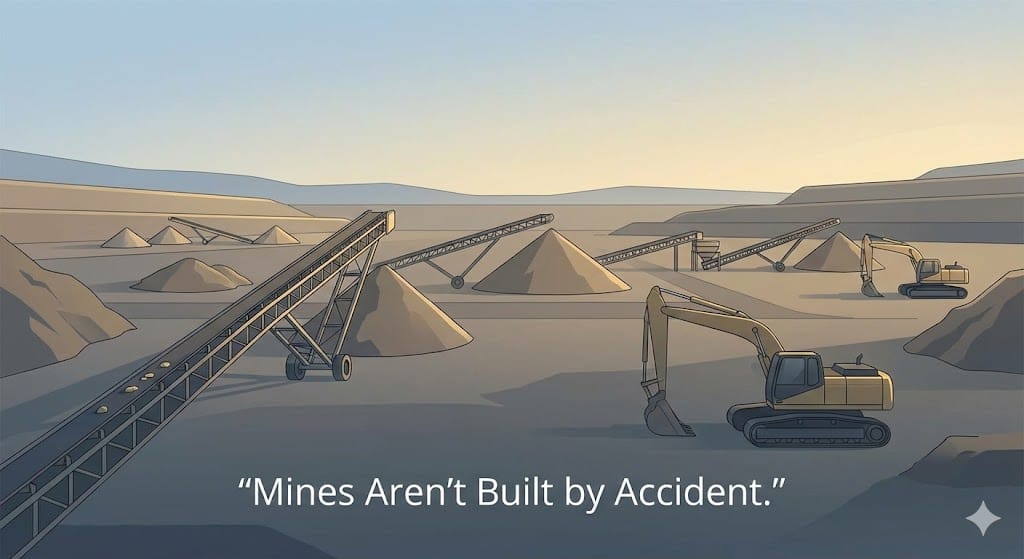
Gold mining is such a tricky business that it’s NEVER an accident if a management team successfully builds a productive mine.
Today, gold analyst Garrett Goggin has found a company run by a team that’s already seen a $1.1 billion buyout - back when gold was $1,500/oz.
Today, this team is doing it all over again, ramping up to first production this January 2026. And with gold at $4,000+, the payout is likely to be much bigger.
But this stock is only selling for ~$500 million…
Garrett just released the full details of this gold stock - free. Click here to see his full write-up.
Accidents vs. Repetition
One successful mine is an accident. Two successful mines is a pattern. Three is a system.
Consider Appian Capital's acquisition of a copper-gold project in Brazil (Serrote/MVV) from Aura Minerals in 2018. The original mine plan called for $420 million in capital expenditure with higher throughput targeting lower-grade material. Appian re-scoped the project: reduce throughput, focus on higher-grade zones, lower the strip ratio. The result: $243 million capex estimate versus the original $420 million.
The team that designed this re-scope—geologists, engineers, metallurgists, and finance professionals working together—then executed construction during the COVID-19 pandemic. They brought the mine into production in May 2021, ahead of schedule and under budget by $48 million. The project has since operated stably for over two years with zero lost-time injuries in the past three years. In 2025, Appian sold the asset to a Chinese buyer for $420 million—the exact amount the original developer had estimated for capex alone.
This is not luck. It is competence. A management team with experience in value engineering, cost control, and operational execution can see what a less experienced team cannot: where corners were cut in the original plan, where overengineering adds cost without safety benefit, where the metallurgy can be simplified without sacrificing recovery.
Compare this to the baseline: most mining projects overrun by 40 percent in cost and 25 percent in schedule. Appian delivered 11 percent under budget. The difference was not genius—it was experience. The team had built mines before. They knew what permitting looked like in specific jurisdictions. They understood processing metallurgy deeply enough to modify it without introducing risk. They had financial discipline baked into their decision-making.
This is repeatable. And when something is repeatable, it becomes a moat. Market participants who understand this moat will pay differently for assets run by teams with proven track records than for assets run by promoters who have never built anything.
The Institutional Framework
Listen to how institutional capital now talks about mining development. Not "How many ounces does the deposit contain?" Instead: "How do you get to production, and how quickly?"
This shift reflects a fundamental recalibration. Gold ounces in the ground are geologically visible but economically worthless until extracted. The conversion from geology to cash flow requires executing a sequence that most teams get wrong.
P2 Gold, advancing its Gabbs project in Nevada, structures its entire investor dialogue around execution visibility. The company outlines a clear permitting sequence: water permits expected in Q4 2025, feasibility study starting January 2026, mining plan filing in early 2026, production targeted for 2028. This is not a best-case scenario. This is a company saying: "Here is the sequence. Here is the timeline. These are the binary milestones."
Why does this matter to institutional investors more than the project's economics? Because economics can change. Commodity prices move. Processing costs inflate. But execution credibility is fixed to the team's history. A management team that has successfully navigated permitting in Nevada multiple times knows the process. A team that has never built a mine in the United States has to learn while managing $400 million in capital.
The valuation gap between experienced operators and first-time executors is not a speculative premium. It is a risk adjustment. The first-time team may succeed. But the probability of schedule slippage, cost overruns, and operational hiccups is measurably higher. Sophisticated capital prices this accordingly.
The Gap Between Headlines and Milestones
Consider Merdeka Copper Gold's Pani Gold Mine in Indonesia. In October 2025, the company officially commenced first mining. This is a critical milestone—the transition from development to extraction. First gold production is targeted for Q1 2026.
This event barely registered in financial media. The gold price did not move. No institutional forecasts were revised. Yet for the people who understood the sequence, October 2025 represented a crucial execution checkpoint: a major project transitioned from engineering to operations on a credible timeline.
The same pattern is visible at other projects advancing toward 2026 production. McEwen's El Gallo project in Mexico secured environmental permits, clearing the path for mill construction mid-2026 and production mid-2027. Orvana's Don Mario facility in Bolivia is conducting phased restarts, with copper coming online Q2 2026 and controlled ramp-up continuing through spring.
None of these are headline events. Gold price movements dominate financial conversation. But assets approaching production generate asymmetric value for investors who see execution clarity before it becomes consensus. The mine that reaches production on schedule gains two to three years of cash generation advantage over peers that slip. That cash flow compounds into significant valuation gaps.
Why Valuation Gaps Persist
Markets misprice development-stage mining assets for a simple reason: they are hard to analyze. Gold ounces and capex estimates are easy to compare across projects. Management track records require research. Permitting timelines require jurisdictional knowledge. Processing metallurgy requires technical understanding.
Retail investors avoid these complexities and focus on the ounce count and the gold price. Institutional investors focus on the execution probability and the team.
This creates persistent gaps. A project with an experienced team, clear permitting pathway, and proven metallurgy often trades below peak-cycle NPV multiples because the market does not recognize these advantages. The market waits for the mine to actually start producing before repricing the asset upward.
By that point, the team executing the project has already de-risked it substantially. Early-stage construction risks (engineering changes, permit delays, discovery issues) have been resolved. The operational ramp-up is the final, lower-risk phase. Once production begins, valuation multiples expand sharply as investors suddenly recognize the company is a producer, not a developer.
But the investors positioned during the permitting phase—the unglamorous phase when nothing was happening on the news wires—have already benefited from the repricing.
The Invisible Hand That Builds Mines
Gold prices get attention. Mines get built quietly, by teams with prior successful projects, in jurisdictions with predictable permitting, using processing routes that have been tested and refined. The names on the press releases are not celebrities. The projects are not household stories. The execution happens in quarterly reports and regulatory filings and engineering reviews that almost no one reads.
This invisibility is structural. Permitting documents are public, but no one reads them. Management biographies are available, but few investors verify prior project outcomes. First-pour events happen, but financial media considers them non-events compared to gold price moves.
The people who understand this—who track which management teams have successfully exited prior projects, who follow permitting sequences in specific jurisdictions, who study the operational ramp-up profiles of comparable mines—operate in an information asymmetry. They see value that headlines obscure.
How Timelines Create Conviction
Successful mining investments share one characteristic: they are built on timeline conviction, not price conviction. The investor believes the team will execute the sequence—permitting, engineering, construction, ramp-up—on a defensible schedule. The investor is comfortable with the commodity price being uncertain, as long as the operational pathway is clear.
This is the inverse of speculation, which assumes commodity prices will behave a certain way while ignoring execution entirely.
The teams that have built mines before know this sequence. They size capital estimates conservatively, not optimistically. They plan timelines with buffer, not pressure. They focus on achieving first production, then optimizing operations. They understand that the first year of production is almost always messier than engineering suggests, so they budget for ramp-up periods rather than hoping for immediate steady-state output.
Investors who partner with these teams benefit from that experience. The mine that ramps to full production 15 percent faster than industry averages will generate substantial additional cash flow. The project that maintains capex discipline within 10 percent of estimates will have capital available for dividend or reinvestment while peers are burning cash trying to recover from overruns.
These advantages compound over the life of mine.
Outcomes Are Built Long Before Prices React
The next major gap in gold mining valuations will not emerge from new geological discoveries or commodity price forecasts. It will emerge when investors recognize that a company has successfully executed all the hard parts—permitting, financing, construction, commissioning—and is entering the easy part: steady-state production.
By the time that recognition becomes consensus, the repricing will be substantial.
But the people who positioned during the difficult middle phase—when the mine was being permitted and built, when headlines were sparse, when market attention was focused on gold prices instead of execution—will have already benefited from the transformation.
In mining, as in most durable businesses, the outcomes are built long before the headlines announce them. The work is done quietly, by teams with track records, in phases that financial media overlooks entirely. Gold prices are visible. Mines are invisible until they start producing.
That invisibility is where the advantage lives.
—
Claire West