Why Liquidity Matters More Than We Realize

Imagine the quiet tension of waiting for a bank transfer to clear—a payment you thought was there, yet inaccessible. For many, the money sitting in a bank account feels like cash in hand, ready to cover bills or emergencies. But all too often, that assumption breaks down. Liquidity, or the ability to quickly use money, is invisible—until it suddenly isn’t. In my own experience, a delayed transfer or unexpected holdforces a sudden reckoning: money on paper isn't always money in hand. This quiet financial reality can destabilize families, especially when times get tough.
What Is Liquidity?
For households, liquidity means having cash, savings, or credit readily available to pay for everyday needs or sudden expenses. It’s your checking account balance, emergency fund, or available credit card limit. For the broader financial system, liquidity refers to money flowing smoothly through banks, markets, and lenders.
Yet, Americans often equate deposits with liquidity. Reality has shown cracks: the 2008 financial crisis, the liquidity crunch during the 2020 pandemic, and recent banking stresses of 2024–2025 reveal liquidity risk exists well beyond Wall Street. This risk touches everyday savers—delays in accessing funds, sudden withdrawal restrictions, and the hidden costs of converting assets to cash.
Liquidity risk is about more than investing portfolios; it affects how smoothly a family can handle monthly budgets and emergencies. When liquidity tightens, even solid savings can feel out of reach.
Banking Crisis 2.0 Is Already Exploding
Behind the scenes, the U.S. banking system is cracking — and you’re not supposed to know why.
The real reason? The government is pushing ahead with a Central Bank Digital Currency (CBDC) — and banks are the first casualty.
- Deposits are vanishing
- Liquidity is drying up
- Quiet bailouts are already happening
And once CBDC replaces your cash, it’s game over: - They’ll track every transaction
- They’ll decide where you can spend
- They’ll shut down your account instantly if you step out of line
This is the new financial surveillance state.
>> Download it now before the next bank collapses <<
Household Liquidity Today
Recent Federal Reserve data reveals trends in liquidity for U.S. households:
- In 2022, liquid assets relative to household income nearly hit 15%, the highest since tracking began, up from 6.2% in 2010. This jump partly reflects pandemic savings and federal aid. However, by late 2023 and into 2024, liquid assets have been declining, especially in savings and time deposits, as households shift funds to checking to cover spending (Federal Reserve, 2024).
- Inflation and rising interest rates have pressured liquidity. Higher prices shrink purchasing power, while rising rates incentivize shifts from liquid savings to longer-term assets, which are less accessible without penalties.
- Recent banking system stress points to tighter liquidity: In early 2025, U.S. bank reserves dropped sharply below $3 trillion (the lowest since 2020), signaling banking institutions are pulling back liquidity to meet regulatory buffer goals amid ongoing quantitative tightening by the Federal Reserve (Global Macro Insights, 2025).
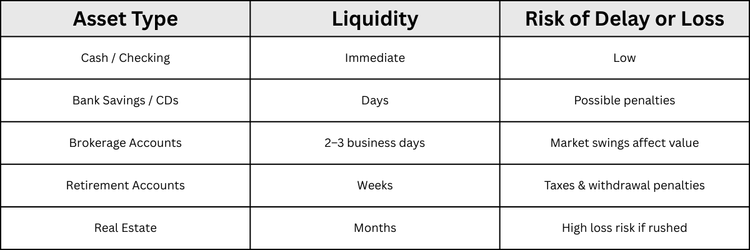
- Withdrawal timelines vary: checking accounts provide immediate access, but savings, CDs, brokerage accounts, and retirement funds all entail delays, penalties, or market risks before funds become usable.
These points illustrate a gap many overlook: the difference between what’s listed on paper and what can be safely used.
A Simple Formula to Understand Liquidity Risk
Liquidity Gap = Assets on Paper − Assets You Can Actually Use
When your liquidity gap widens, cash-flow crises loom.
Asset Liquidity Comparison Table
Practical Checklist: Managing Liquidity Wisely
- Keep a portion of savings liquid, using cash and checking accounts for immediate needs.
- Diversify deposits across multiple banks and include different asset types to reduce risk.
- Know the withdrawal timelines and penalties for all accounts you hold.
- Monitor Federal Reserve policies and market signals about liquidity to anticipate tightening.
- Balance your portfolio between growth-oriented assets and easily accessible funds.
- Prepare calmly with a strategy focused on resilience, not fear.
Freedom Comes from Access
Liquidity rarely makes headlines. It’s not about bold forecasts or market buzz, but the quiet shield that protects families in moments of crisis. The ability to access funds quickly can mean the difference between steady footing and financial shock.
In uncertain times, preparation trumps prediction. Understanding and managing liquidity is about securing freedom—freedom from worry, from last-minute scrambles, from unexpected financial holds. It may be unseen, but liquidity is the foundation of financial security.
—
Claire West