The Phone in Your Pocket Is Not a Paycheck

🚨Heads up! It's not the publicly traded tech giant you might expect…
Meet $MODE, the disruptor turning phones into potential income generators. Retail investors are buzzing about the company's pre-IPO offering.
📲Mode saw 32,481% revenue growth over a three year period, ranking them the #1 overall software company on Deloitte’s 2023 fastest-growing companies list.They aim to pioneer " Privatized Universal Basic Income " powered by technology—not government. Their flagship product, EarnPhone, turns phones from an expense into an income stream, and they’ve already helped consumers earn & save $1B+.
Uber did it to taxis, Airbnb to hotels and now Mode Mobile is doing it to the $500 billion smartphone industry. The difference? Early investors like you can invest in their pre-IPO offering at just $0.50/share and earn up to 20% bonus.
59,000+ shareholders already invested $71M+ and they may soon reach a point where they no longer accept outside investment.
🔒 With their Nasdaq ticker $MODE secured, investors now have a limited time to invest before they potentially go public.
Early investors can earn up to 20% bonus shares.
Please read the offering circular and related risks at invest.modemobile.com. This is a paid advertisement for Mode Mobile’s Regulation A+ Offering. Mode Mobile recently received their ticker reservation with Nasdaq ($MODE), indicating an intent to IPO in the next 24 months. An intent to IPO is no guarantee that an actual IPO will occur. The Deloitte rankings are based on submitted applications and public company database research, with winners selected based on their fiscal-year revenue growth percentage over a three-year period. Pro forma revenue and EBITDA, includes full year numbers of the businesses acquired throughout 2025.
It Is an Economic Interface — and the Value Flows Mostly One Way
Pick up your phone. Check the time. Open an app. Pause for three seconds on a video before scrolling on.
That sequence — repeated 205 times a day by the average American, according to a January 2025 report cited by Reviews.com — is not passive behavior. It is participation in a precisely structured economic system. Every pause, swipe, and tap generates a data signal. That signal is collected, processed, and sold. The question worth asking is not whether your phone can make you money. It is: who is profiting from your attention, and what does the architecture of that exchange actually look like?
From Tools to Platforms
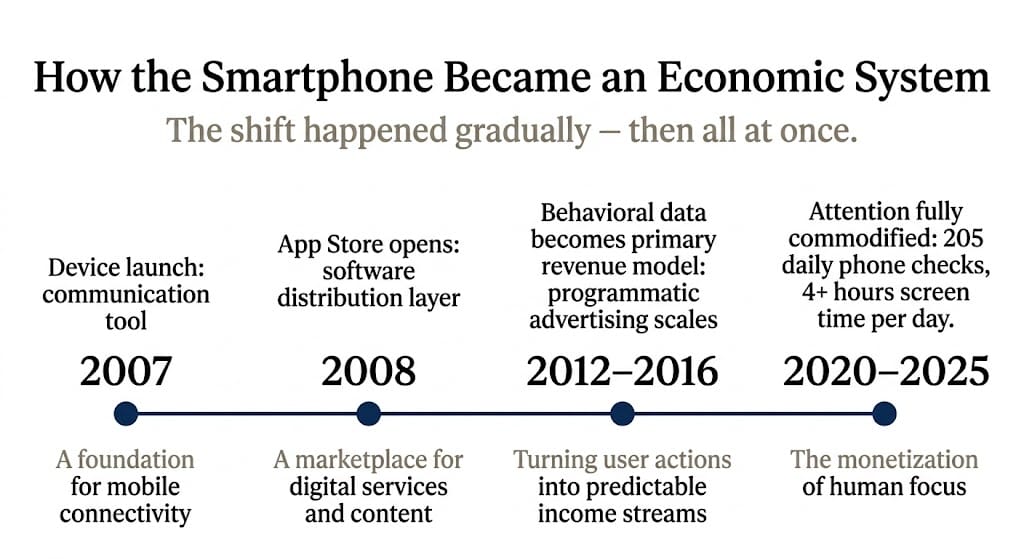
The smartphone did not begin as an economic interface. It began as a communication device — a pocket computer that replaced the calendar, the camera, and the map.
The transformation happened quietly, through the logic of free services. To use these services at no financial cost, users accepted an implicit exchange: access in return for behavioral data. What Shoshana Zuboff termed "surveillance capitalism" in her foundational analysis describes this dynamic precisely — user experience becomes the raw material from which "behavioral surplus" is extracted, processed into prediction products, and sold in behavioral futures markets to advertisers and corporate clients. The phone, in this model, is less a tool than a continuous sensor.
By 2025, U.S. adults spend an average of over seven hours daily on screens, with smartphones accounting for more than four of those hours. Americans check their phones approximately 205 times a day. At that usage level, the device is not an occasional utility. It is a permanent behavioral feed — and the infrastructure extracting value from that feed operates at industrial scale.
The Monetization Layer
The attention economy rests on a two-sided market model: users receive free services on one side; advertisers pay for targeted influence on the other. Platforms have refined this model with remarkable precision.
McKinsey research found that a 10% increase in average consumer focus across mediums correlates with a 17% increase in spending and a 20% increase in likelihood to purchase from advertisements. Consumers in the top quartile of attentiveness spend twice as much as those in the bottom quartile. That relationship — between captured attention and downstream commercial behavior — is the core revenue mechanism of the modern app economy.
The layers are multiple. In-app advertising remains the dominant model, with 31% of apps globally relying on it as a primary revenue source. In-app purchases represent a second layer, with the global IAP market projected to grow from $257 billion in 2025 to $657 billion by 2029. A third layer — data monetization — involves the sale of anonymized behavioral, browsing, location, and purchase data to market researchers and corporations. Each of these models extracts commercial value from time spent on the device, regardless of whether the user perceives themselves as a participant in an economic transaction.
Phone as Expense vs. Phone as Economic Interface
| Phone as expense | Phone as economic interface |
|---|---|
| Monthly carrier bill: $50–$100 | Average American generates behavioral data worth significantly more annually to platform advertisers mckinsey |
| Subscription fees for apps and streaming | Attention sold in real-time to advertisers via programmatic auctions during every session tresor.economie |
| Device purchase cost | Location, purchasing intent, and browsing history continuously resold to third parties scrimpr |
| Passive consumer experience | Active supplier of behavioral surplus to prediction markets hbs+1 |
| Feels like leisure | Structured participation in a commercial data collection system humanetech |
The Illusion of Passive Income
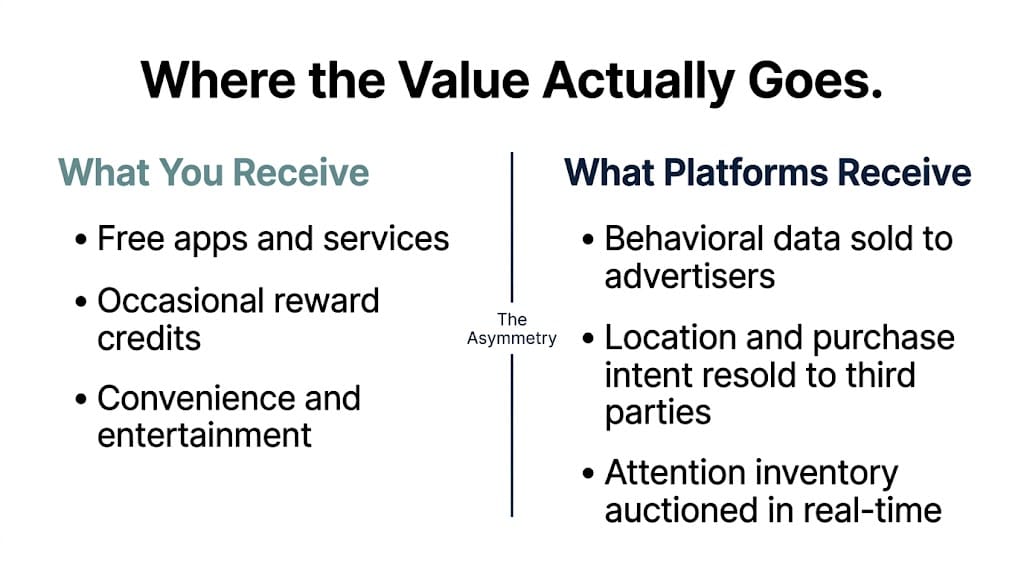
In recent years, a parallel narrative has emerged: that users can "earn" from their phones through reward apps, data-sharing platforms, and engagement incentives. The mechanics are real but modest. Data-sharing apps that pay for browsing history typically return £3–10 per month; receipt-scanning apps offer fractional payments per upload; mobile research panels offer $5–10 monthly in gift cards. Realistic aggregated earnings from stacking multiple such apps tend to fall below £40 per month in the most optimistic scenarios.
The structural logic here deserves examination. When a platform rewards a user for behavioral data, it is essentially redistributing a fraction of the commercial value it extracts — while retaining the majority. This is not income generation; it is value sharing, at terms set entirely by the platform. The user supplies the raw material (behavior, attention, data), and the platform determines how much of the derived commercial value, if any, flows back.
Researchers analyzing the attention economy note that the fundamental asymmetry is not accidental — it is the business model. Platforms use algorithmic content curation, variable reward schedules, and notification design to maximize time-on-screen, because each additional second of engagement generates additional data and additional advertising inventory. The user's experience is engineered, not neutral.
Case Lens: Companies Formalizing the Model
Several companies have attempted to restructure this exchange by making the reward mechanism explicit — building platforms where behavioral engagement earns points, credits, or direct payments rather than leaving the extraction invisible.
The underlying economics remain constrained by the same fundamentals. Advertisers pay on the order of fractions of a cent per impression for broad audiences; premium targeted placements command more, but the per-user yield across a large base still requires significant scale to produce meaningful user payouts. Platforms operating on thin per-engagement margins must manage user acquisition costs, retention rates, and payout structures simultaneously — a unit economics challenge that grows more difficult as user bases scale.
Attention economy fatigue adds further pressure. Research published in 2025 finds that information overload strongly predicts platform-switching behavior, and ad fatigue changes optimal engagement curves — returns diminish faster with repetition. Platforms competing for sustained behavioral engagement are fighting both platform competition and the biological limits of human attention.

Risk Lens
The structural risks in this space are not primarily regulatory — they are economic and behavioral.
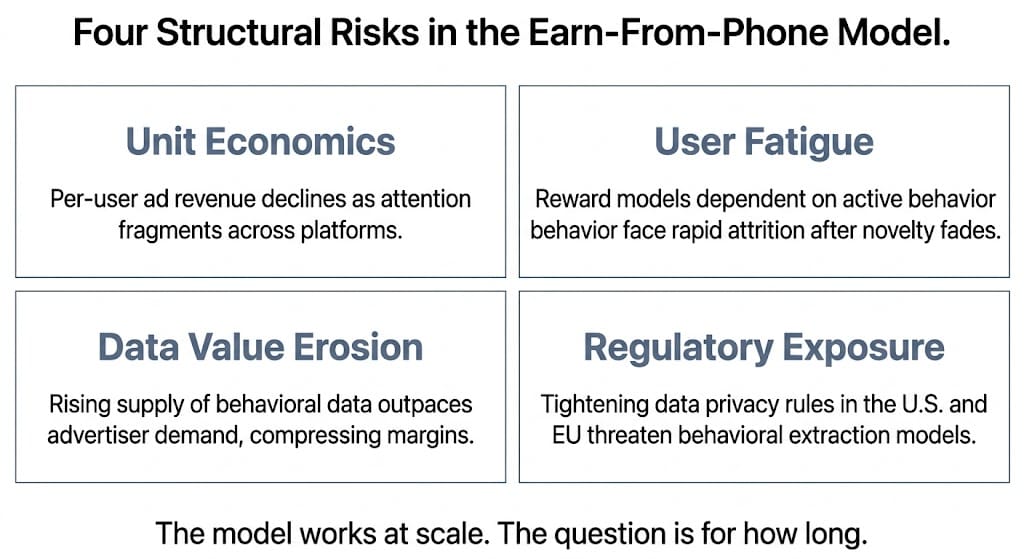
Unit economics at scale. Per-user advertising revenue is a function of attention quality, not just quantity. As platforms proliferate and attention fragments, the average yield per hour of engagement tends to decline. Platforms offering user rewards must therefore either maintain unusually high engagement metrics or accept that payouts compress their already-thin margins.
User fatigue and churn. A 2024 academic study found that information and communication overload predicts platform-switching, not increased engagement. Reward structures that require active behavioral participation — checking in, completing tasks, watching content — are particularly vulnerable to attrition once novelty diminishes.
Data value erosion. The expanding volume of behavioral data generated globally is not matched by proportional growth in advertiser demand. As supply increases, the marginal value of each data point tends to decline. Platforms dependent on data sale revenues face structural headwinds as the market matures.
Regulatory exposure. European and, increasingly, U.S. regulatory frameworks are tightening around behavioral data collection, third-party tracking, and consent mechanics. Companies whose revenue depends on continuous behavioral extraction face compliance costs and potential structural changes to their data practices.
The smartphone is not a paycheck. But it is, structurally, an economic instrument — one that generates and distributes value continuously, largely in directions the user does not observe.
The more useful framing is not "can I earn from my phone" but "who earns from my behavior, and under what terms." That question has a clear answer: the platforms that designed the systems you use daily, the advertisers who pay for access to your predicted behavior, and — at the margins — the emerging category of companies that formalize a small portion of that redistribution back to the user.
The future of this model is not free income. It is structured participation — knowing that your attention is the product, your behavior is the data, and the terms of the exchange are written by others. Understanding that architecture is not pessimism. It is the beginning of making informed choices about where you spend the one currency that cannot be replaced: your time.
—
Claire West