Where the Interface Ends and the Environment Begins
In February 2026, Elon Musk merged SpaceX and xAI, and announced plans to put AI computing infrastructure into orbit.
His words: "Space-based AI is obviously the only way to scale."
Big bet. But it raises one question nobody is asking:
If AI lives in orbit, what does the human interface look like?
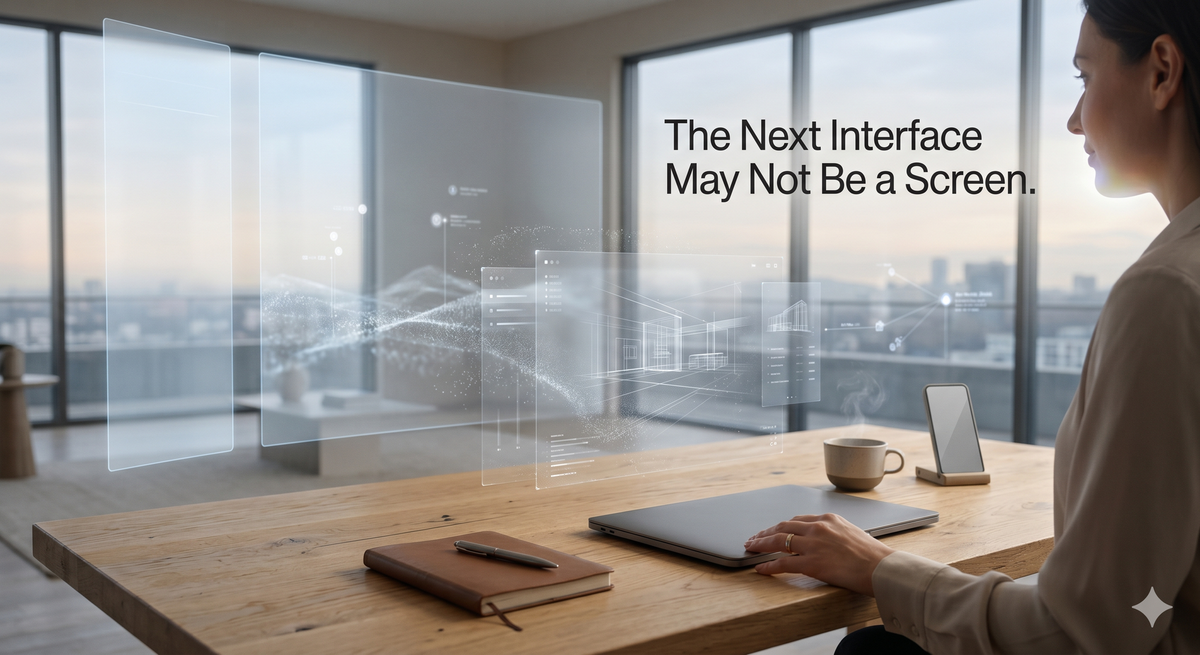
Not a laptop. Not a phone. Spatial Computing. A virtual workspace where AI sees what you see and acts in real time.
That's exactly what Immersed is building.
- 1.5M+ users on Apple, Meta AND Samsung
- Curator AI agent - already live
- Visor headset - already shipping
- NASDAQ ticker $IMRS - reserved
- Intel's ex-CEO invested. A multi-billinaire founder put in $2M+.
The market is headed to $1 trillion by 2034. The round is nearly full.
You can still get in at $0.79/share, but not for long.
➙Invest Before the pre-IPO Window Closes
Every major era of computing produced two revolutions, not one.
The first revolution was technical: more processing power, faster memory, cheaper storage, better algorithms. This is the revolution that generates headlines, investment theses, and conference talks. The second revolution was behavioral: it changed where humans physically sat relative to machines, how they moved their hands, what they expected cognition to feel like.
The mainframe required operators. The personal computer required a desk. The smartphone required a thumb. Each transition created new economic ecosystems not because the underlying software was more powerful, but because the interface layer changed who could participate, how often, and on what terms.
Today the investment conversation about AI is almost entirely about the first revolution: chips, models, training clusters, inference costs. The second revolution — the interface layer, where humans will actually encounter AI — receives far less rigorous attention. That asymmetry is worth examining.
The Forgotten Layer
There is a practical explanation for why compute dominates the analysis: it is quantifiable, capital-intensive, and already generating auditable revenue. The companies building training clusters and selling accelerators have balance sheets that can be modeled.
Interface is harder to model because it is earlier and more uncertain. Interface transitions tend to be dismissed until they are obvious — and by the time they are obvious, the early platform advantage has already been captured.
The pattern is consistent. In the early 1990s, the internet's infrastructure attracted capital, but the browsers and web applications that defined consumer behavior arrived later, built by companies that were small or nonexistent during the infrastructure buildout. In the mobile era, chip manufacturers and handset assemblers captured the first wave of value — but the operating system layer and the app economy that followed generated durable platform leverage that persisted for over a decade.
Interface economics follow infrastructure economics with a lag. The question is what form the next interface layer will take.
From Desktop to Mobile to Spatial
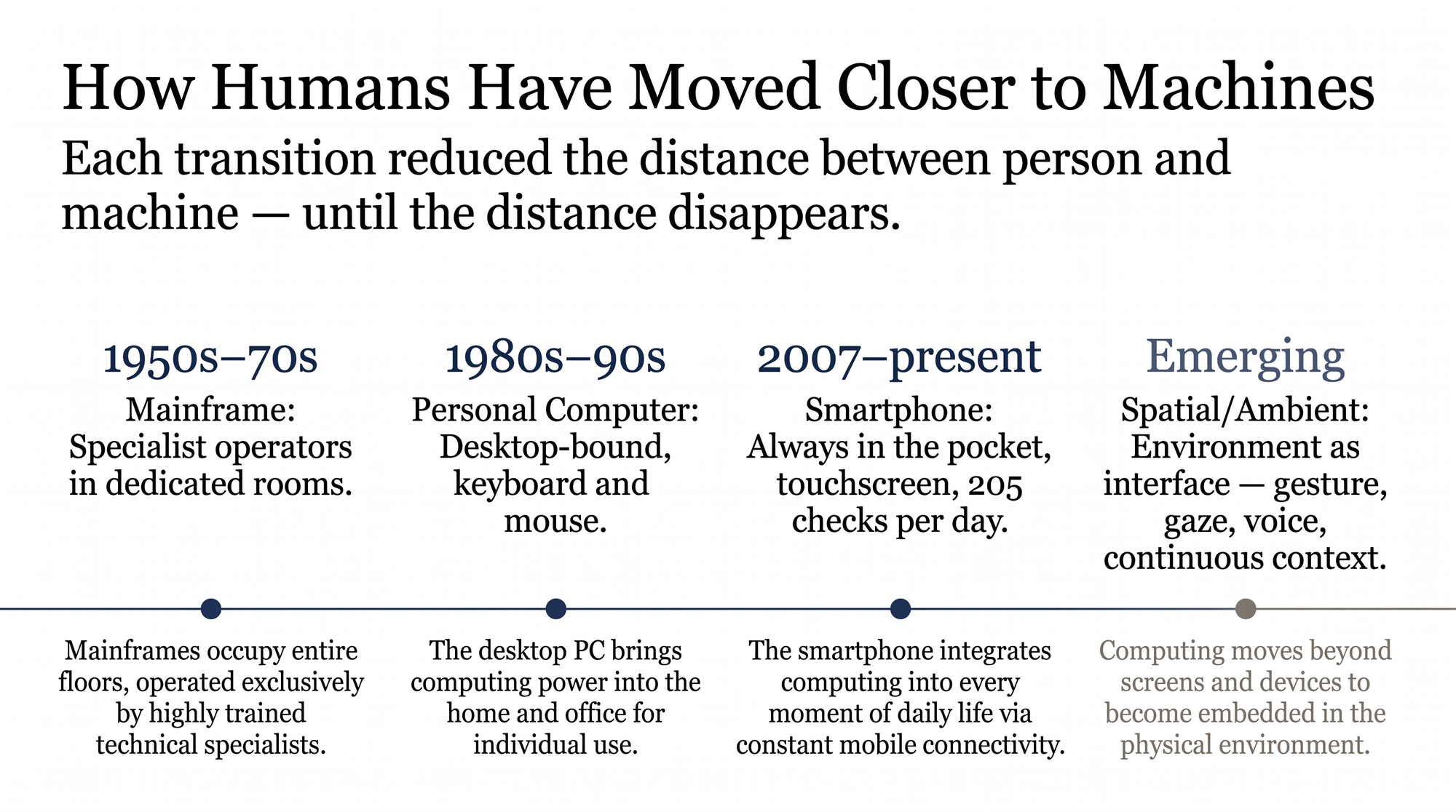
The evolution of human-computer interaction can be read as a series of reductions in physical distance between person and machine.
The desktop required a dedicated room, then a dedicated desk. The laptop allowed mobility within buildings. The smartphone collapsed the distance to zero — a networked computer always in the pocket, always on. The interface evolved accordingly: from keyboard and mouse to touch, from fixed to ambient.
Spatial computing represents the next proposed reduction: not a device you carry, but an environment you inhabit. Research on spatial computing and extended reality describes a model in which digital content is embedded in and responsive to physical space — understanding walls, furniture, gestures, gaze, and environmental cues — rather than requiring users to adapt to screens. Unlike smartphones, which demand episodic and intentional engagement, emerging ambient interfaces integrate mediation into perception itself, enabling continuous, often invisible interaction with intelligent systems.
By 2030, lightweight XR wearables — particularly smart glasses — are expected by several technology forecasters to become mainstream for everyday tasks, potentially displacing smartphones for many use cases.
Computing Era vs. Human Interface
| Computing era | Primary interface | Behavioral requirement | Platform economics |
|---|---|---|---|
| Mainframe (1950s–70s) | Command line, punch cards | Specialist operator training | Closed, institutional sciencedirect+1 |
| Personal computer (1980s–90s) | Graphical user interface, keyboard, mouse | Desktop-bound attention | Software and application ecosystems sensomatic+1 |
| Mobile (2007–present) | Touchscreen, apps | Episodic, thumb-driven, always-available | App stores, in-app purchasing, advertising networks sciencedirect |
| Spatial/ambient (emerging) | Gesture, gaze, voice, environment | Continuous, context-aware, ambient | Platform layers still forming frontiersin+2 |
Why AI Changes Interface Design
The relationship between AI capability and interface design is not decorative — it is structural.
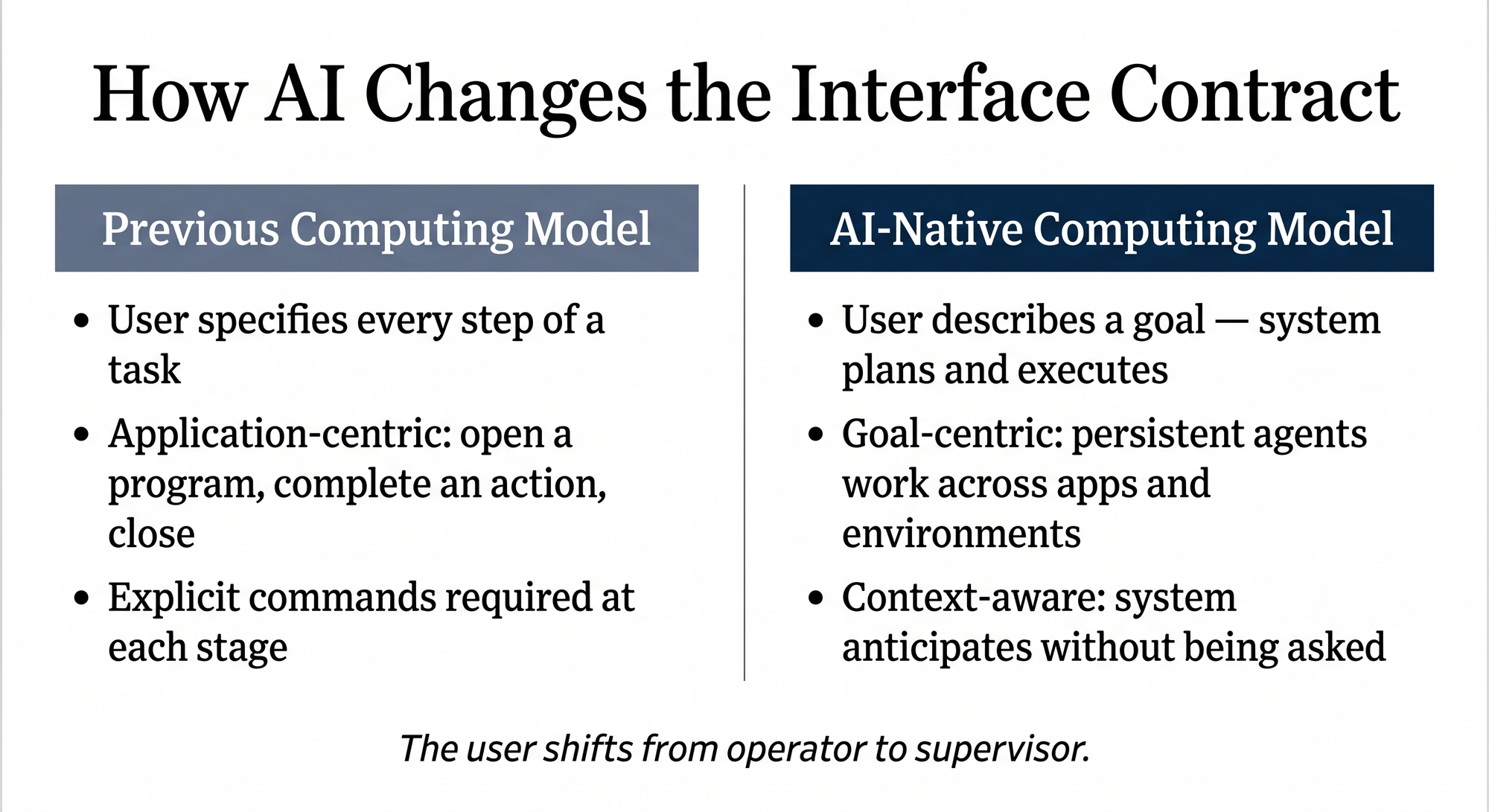
Previous interface transitions were primarily about making the same computing actions easier and more accessible. Spatial computing, combined with AI, introduces a different dynamic: systems that do not wait for explicit commands but instead maintain persistent context, anticipate needs, and act on behalf of users.
Research on AI-native operating systems describes this as a shift from "application-centric computing" to "goal-centric computing": instead of specifying each step of a task, the user describes a desired outcome, and the AI system plans and executes the necessary actions using available tools. The user's role shifts, in this framing, from operator to supervisor.
Ambient agents — a category of AI software designed to run continuously in the background, recognizing context and acting without explicit prompting — represent a concrete early version of this transition. They are contextually aware, multimodal, and distributed across devices and environments. The cognitive load of "being on call" — managing calendars, monitoring systems, coordinating information — transfers from the human to the agent.
This is not merely a software upgrade. It changes the economics of attention, the nature of productivity software, and the platform leverage that whichever operating environment captures persistent AI agent presence will hold.
Mini-Case: Emerging Environments
The current generation of spatial computing hardware — Apple Vision Pro being the most prominent — represents a threshold moment.
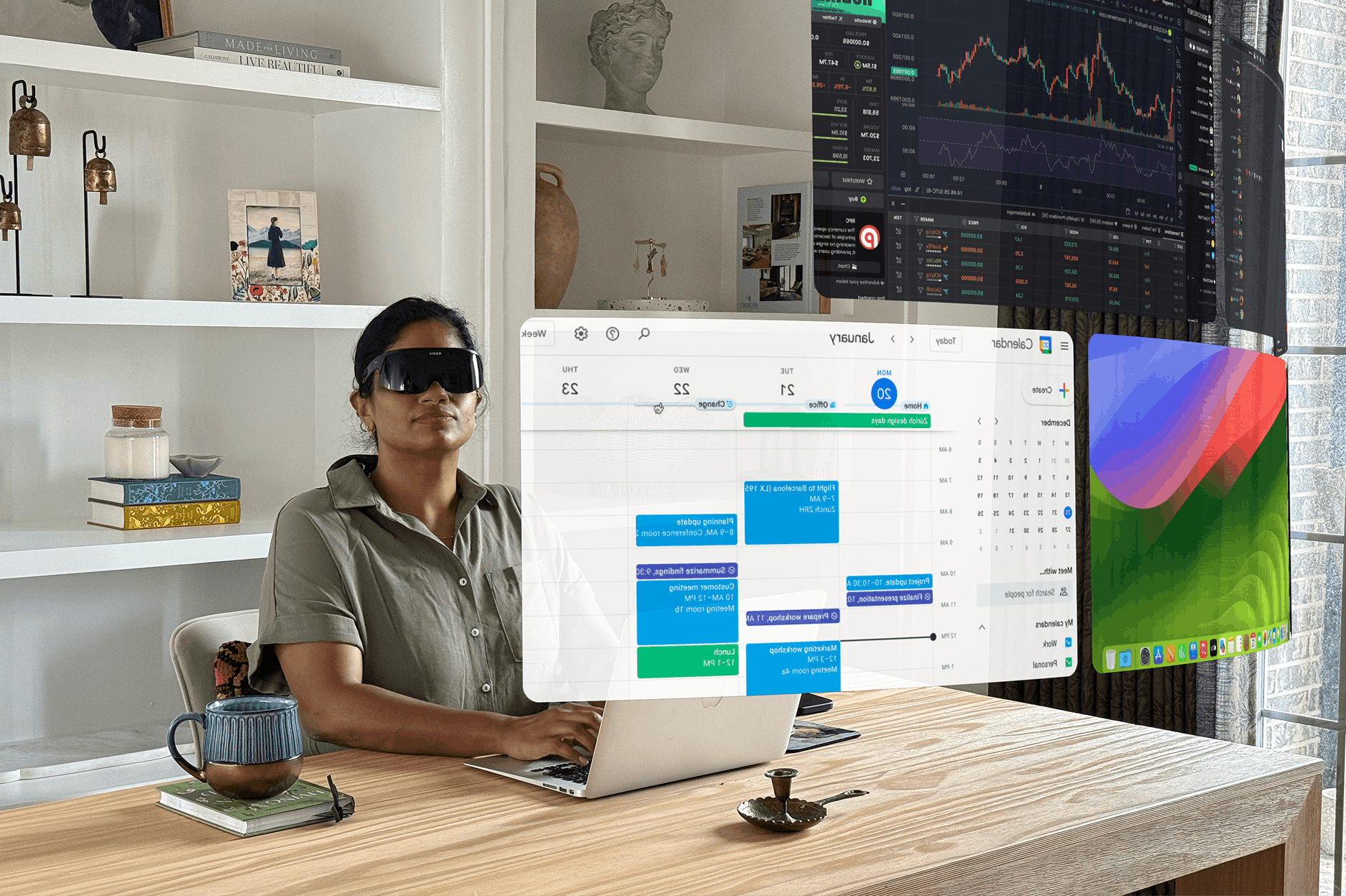
Contrary Research's analysis of the Vision Pro describes it as the first headset to reach the performance threshold required for practical work: spatial arrangement of digital files in physical locations, interaction through natural hand movements, and display quality sufficient to replace a multi-monitor desk setup. The implications are not primarily entertainment — they are about whether a headset can replace the laptop as the primary cognitive environment for knowledge workers.
Several enterprise-focused XR and spatial productivity tools are positioned around this exact premise: persistent virtual workspaces, multi-window layouts freed from physical desk constraints, and real-time AI tools embedded in the work environment rather than accessed through separate applications.
The #1 AR/VR productivity platform with 1.5M active users, a 4K-per-eye Visor lighter than a smartphone, and an AI assistant that transforms the workday. Shares available at $0.79 with limited pre-IPO allocation. Up to 20% bonus shares for early investors.
Immersed
Risk Lens
Interface transitions face a category of friction that infrastructure buildouts do not: human behavioral adoption.
Hardware fatigue is real and well-documented. Early iterations of wearable computers — Google Glass, the first generation of VR headsets — demonstrated that consumer tolerance for form factor discomfort, social awkwardness, and battery constraints can delay adoption by a decade or more regardless of technical capability. The mass-market version of spatial computing may require several more hardware generations before the friction falls below consumer tolerance thresholds.
Consumer behavior in this space is also genuinely unclear. Enterprise adoption — industrial maintenance, surgical guidance, architectural review — follows a different calculus than consumer adoption. The immersive productivity case for knowledge workers involves changing deeply embedded behavioral habits around screens, keyboards, and posture. Early adopter enthusiasm rarely predicts mass-market uptake accurately.
There is also concentration risk in the platform layer. If spatial computing ecosystems follow the mobile pattern, two or three platform owners will capture disproportionate interface leverage — and the companies building experiences within those ecosystems will operate under terms set by the platform owner. The history of the App Store suggests this is not a minor consideration for companies building within someone else's operating environment.
Finally, the timeline is uncertain. Infrastructure investment in AI is already measurable. Interface transition timelines are harder to forecast, and capital committed to early platform positions must survive longer periods of unclear consumer behavior before returns become visible.
The next platform shift is likely to be less about better software and more about where cognition happens.
The progression — from desk to pocket to environment — follows a logic that has been consistent across every computing generation: the interface moves closer to the human, requires less translation between intent and action, and eventually disappears into the texture of daily life.
AI does not change that trajectory. It accelerates it. When systems can maintain persistent context, anticipate needs, and act across environments without explicit prompting, the interface question becomes architectural: which environments, which operating layers, and which ambient agents will mediate the relationship between human cognition and digital capability?
The compute story is already being told loudly. The interface story is quieter, earlier, and — for those thinking in platform terms — arguably more structurally interesting.
—
Claire West
Disclaimer: Immersed is offering securities through the use of an Offering Statement that has been qualified by the Securities and Exchange Commission under Tier II of Regulation A. The valuation is set by the Company and there is currently no public market for the Company's Common Stock. Please read the offering circular and related risks at invest.immersed.com. Nasdaq ticker “IMRS” has been reserved by Immersed and any potential listing is subject to future regulatory approval and market conditions.